





Phoenicians: Creating what is now known as the Alphabet – Ancient Origins

Ancient Origins Magazine
Evolution of Languages and Writings
Decoding Astronomy in Art and Architecture
Origin of the Zodiac: Cadair Idris and the Star Maps of Gwynedd
Viking Jewelry
Nexus Magazine
Armstreet
Inner Traditions
A-B-C-D-E-F-G … This famous sequence of letters known to much of the world dates back to the 16th century BC. A fairly small group of traders and merchants known as the Phoenicians created the foundation for the modern English alphabet and other alphabets. They organized a system of 22 consonants into what became the alphabet used not only by English speakers, but by speakers of many of the world’s languages.
The Phoenicians lived along the Mediterranean coast in what is now Lebanon. They inhabited a number of different city-states, the most famous of which were Tyre, Byblos, and Sidon. These Phoenician places were often in conflict with each other for domination of the region. Because of this lack of cooperation, the Phoenicians were conquered and forced to pay tribute to the virtually every empire in the region, including the Egyptians, Hittites, Assyrians, Babylonians, Persians, and Greeks.
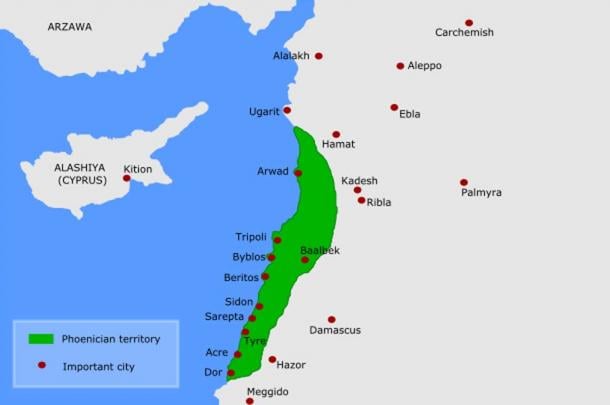
Map of Phoenicia.
Map of Phoenicia. ( CC BY 3.0 )
When the Phoenicians created their new alphabet, they worked from symbols that were already in use among the Semitic-speaking peoples of Canaan and Mesopotamia. As early as 3000 BC, the Sumerians and the Egyptians had already invented writing systems based on symbols. These early scripts were primarily used by merchants and traders to record contracts, receipts, and lists of goods.

The merchants and traders of Phoenicia wanted something that would not be too difficult to learn and would be quick and easy to use. Unfortunately, both the Egyptian and Sumerian writing systems did not meet these criteria very well. They used hundreds of different complex symbols to represent ideas (ideograms) and syllabic sounds (phonograms).
The Phoenician alphabet.
The Phoenician alphabet. ( Public Domain )
The Phoenicians realized that most words were made up of only a small number of simple sounds. They found that these sounds could be represented in only 22 symbols and their various combinations. In their newly created alphabet, the Phoenicians used symbols or letters only for consonants, although their spoken language did contain vowel sounds. The modern Hebrew and Arabic alphabets, which were directly influenced by the Phoenician one, still do not contain symbols for vowels.
The Phoenicians spread their alphabet through their vast trading network that stretched throughout the entire Mediterranean region. The Greeks adopted it and by the 8th century BC had added vowels. Later, the Romans also used a version of this same alphabet that is virtually identical to the one used today in the English-speaking world.

The Phoenicians were the greatest traders in the ancient world for the period between 1000 BC and 600 BC. These were highly skilled shipbuilders and sailors built strong and fast sailing vessels to carry their goods. They learned how to navigate and how to use the North Star to sail at night. It is possible that they even sailed as far as Britain and around the southern tip of Africa.
Map of Phoenicia and its Mediterranean trade routes.
Map of Phoenicia and its Mediterranean trade routes. ( CC BY-SA 3.0 )
To fight off pirates who often harassed trading ships, the Phoenicians designed special warships to accompany their trading fleets. Oarsmen would propel a sharp ramming device at the front of the boat into an enemy’s vessel, putting a hole into it that would cause it to sink.
To expand in trading, the Phoenicians also built outposts that later became great cities in their own right. The most famous of these outposts was Carthage (located in modern-day Tunisia). Carthage eventually became wealthy and powerful enough to challenge the Roman Republic.
Phoenician merchants acted as middlemen for their neighbors. They transported linen and papyrus from Egypt, copper from Cyprus, embroidered cloth from Mesopotamia, spices from Arabia, and ivory, gold, and slaves from Africa to destinations throughout the Mediterranean.
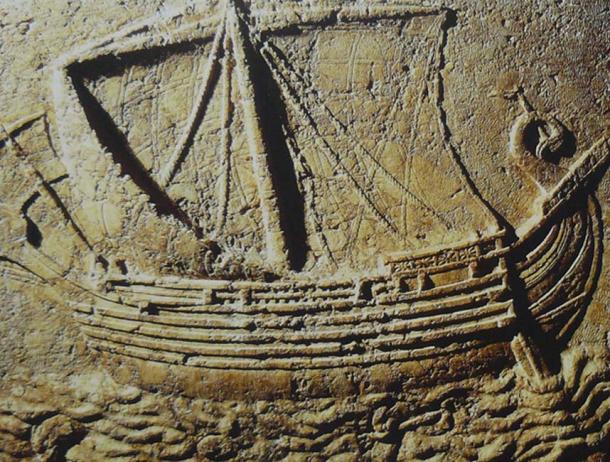
Phoenician ship Carved on the face of a sarcophagus.
Phoenician ship Carved on the face of a sarcophagus. ( CC BY-SA 3.0 )
The Phoenicians also had valuable resources and highly skilled artisans. From a small shellfish called the murex they produced a brilliant purple dye. This dye was applied to woolen garments, which were highly prized not only for their beauty, but also for their high cost. It took 60,000 murex to produce one pound of dye. The dye became known as royal purple and was worn by Roman emperors.
Skilled artists also produced beautiful glass, pottery, textiles, woodwork, and metalwork, that were desired by people all over the ancient world. King Solomon of Israel even used Phoenician artisans and resources to build the great Hebrew Temple to Yahweh.
By 572 BC, the Phoenicians fell under the harsh rule of the Assyrians. They continued to trade, but encountered tough competition from Greece over trade routes. As the 4th century BC approached, the Phoenicians’ two most important cities, Sidon and Tyre, were destroyed by the Persians and Alexander the Great. Many Phoenicians left the Mediterranean coast for their trading colonies, and Phoenicia people and ideas were soon assimilated into other cultures.
Top image: Phoenician ship ( CC BY-SA 3.0 ) and Phoenician Alphabet ( Public Domain )
ushistory.org. (2016, September 20). Phoenicians: Sailing Away. Retrieved from Ancient Civilizations Online Textbook: http://www.ushistory.org/civ/4f.asp
This is the Ancient Origins team, and here is our mission: “To inspire open-minded learning about our past for the betterment of our future through the sharing of research, education, and knowledge”.
At Ancient Origins we believe that one of… Read More
Where did they source the wood which would have been integral to the maritime culture of big wooden ships?  That part, among other things, doesn’t add up.  Of course, prior to the Ice Age (circa 110k BC), the entire region was lush/forested, suggesting again (as typical) some deceptive play with historical dating to fit false narratives.  As for the alphabet, the Semites brought their own (from Sumeria, and from somewhere else in the galaxy before that) next to the long-established ancient Greek (Earth-aboriginal) symbols.
Nobody gets paid to tell the truth.
The origin of the alpha bet has been traced to the Nile Delta about 1850 BCE. That is the time when Jacob and his family moved there, driven by drought in Canaan. When the Israelites escaped in 1453 BCE, they took their alephbet with them, as the writings on the rocks on the Exodus route show. When they finally began the conquest of Canaan, each tribe was allotted a territory. The tribe of Dan was allotted the area then controlled by the powerful Philistines. Unable to defeat them (even with the Ark), the tribe of Dan migrated northward, all the way to Lachish in Lebanon. The Torah says they slew the inhabitants, but actually they assimilated wth them. Lachish was a city allied with Sidon, and over time, the tribes fused. That is how the Israelite alephbet came into the hands of the Sidonian Phoenicians. In later migrations, the tribesmen of Dan went to Ireland.
Another product of ((( Stalin's ))) total reeducation.
Eg. The Dorian Greeks are called the Dorian Greeks because they came from Dor. Alexander considered himself Hellen by implicitly stating so and spreading Hellenic culture to the barbarians.
Oh and the northern province of Greece is called Macedonia and has been so for over 2000 years.
Go steal someone else's history
That is the real truth about so called Greek alphabet, the real inventors of the so called Greek alphabet were Phoenicians and not so called ancient Greeks. The Phoenician princ Cadmus came and settled on Peloponnese, he was the founder and the first king of Thebes. He brought with him nothing but their own language and alphabet. After him on Peloponnese came and settle Egyptian princ Danaus, he was the founder and king of the famous city of Argos, his twin brother was Aegyptus. In Homer's Iliad, "Danaans" ("tribe of Danaus") and "Argives" commonly designate the Greek forces opposed to the Trojans. Those people are the real Hellens, because of them today,s modern country Greece is called Hellas or by Greeks Ellada, ethymology- Ellada-ella which means ¨CAME or someone who Came-The newcomers. These two princes destroyed or led to destruction of the ancient civilization of the indigenous people who lived there. Because of them, the modern Greeks encountered phenotypes aand genotypes of dark skinned people. And as you know Alexander the Macedon was not Hellen, he was Blond and true Macedonian..
The Aleph Bet was devised by Kenaanite laborers and slaves in Egypt and moved with them to the Levant as a whole as they were expelled from Egypt


Ancient Origins Store
Anatolia Turkey
IRAN Expedition
SUDAN Expedition
All Expeditions
Ancient Origins DNA
Natural History
Ancient Origins Magazine
Historic Mysteries
 
 
Ancient Origins has been quoted by:

Ancient Origins Quotations
At Ancient Origins, we believe that one of the most important fields of knowledge we can pursue as human beings is our beginnings. And while some people may seem content with the story as it stands, our view is that there exist countless mysteries, scientific anomalies and surprising artifacts that have yet to be discovered and explained.
The goal of Ancient Origins is to highlight recent archaeological discoveries, peer-reviewed academic research and evidence, as well as offering alternative viewpoints and explanations of science, archaeology, mythology, religion and history around the globe.
We’re the only Pop Archaeology site combining scientific research with out-of-the-box perspectives.
By bringing together top experts and authors, this archaeology website explores lost civilizations, examines sacred writings, tours ancient places, investigates ancient discoveries and questions mysterious happenings. Our open community is dedicated to digging into the origins of our species on planet earth, and question wherever the discoveries might take us. We seek to retell the story of our beginnings. 
Ancient Origins © 2013 – 2022
Disclaimer – Terms of PublicationPrivacy Policy & CookiesAdvertising Policy – Submissions We Give BackContact us

source

UW Religion Today: The Alphabet: The Heritage of the Canaanites | News – University of Wyoming News

Skip to Main Content
 
Institutional Communications
Bureau of Mines Building, Room 137
Laramie
Laramie, WY 82071
Phone: (307) 766-2929
Email: cbaldwin@uwyo.edu
By Paul V.M. Flesher
When Christians think about the Canaanites, it is usually to recall their supposed disappearance after the Israelites conquered their land in the 13th century B.C. The Canaanites were supposedly one of the many small peoples of the Mediterranean world who vanished without a trace during the great movements of peoples at this time. 
There are two things wrong with this picture. First, the Canaanites did not disappear, but instead became one of the dominant nations of the time. Second, they amalgamated into the Roman Empire many centuries later and left a legacy that remains with us today: namely, the alphabet.
The Canaanites lived along the eastern Mediterranean shore for most of the second millennium B.C. The strip of land they occupied extended about 25 miles inland, to the northern end of the Great Rift Valley through which the Jordan River runs. The territory’s southern end reached nearly to Egypt, while its northern end stretched across the land today known as Lebanon. The Israelites and the Philistines occupied only the southern end of this territory in the 13th century. 
In what would become the 20th century nation of Lebanon, the Canaanites became expert seafarers and traders. The great east-west trade route of the age ran through their land. This group of mobile Canaanites became known by another name, that of Phoenicians. They traded along the Mediterranean coast and sailed out into the islands, where they came into contact with Greek civilization, and to the west where they established Carthage — Rome’s first major opponent. It was through this trading empire that the Phoenicians spread their greatest intellectual achievement: namely, the alphabet.
In the middle of the second millennium B.C., the Phoenicians created the first alphabet — before the appearance of the Israelites in the southern portion of their territory. The importance of this achievement lies not merely in the creation of a writing system of 22 letters, but in the idea of an alphabet as a way to represent speech in a written form. 
Prior to the Phoenician achievement, all writing had been done by syllabaries. A syllabary is a collection of signs that represent each different syllable of a language. For example, to represent English syllabically, imagine a sign (i.e., a letter) for each combination of consonant plus vowel. This would result in different signs for ba, be, bo, ca, ce, co, etc. In the end, there would be hundreds of different letter signs that writers and readers would need to memorize. This kind of awkward writing system was in use by the great empires up to this time: Sumer and Akkad in Mesopotamia (i.e., modern Iraq) and Egypt along the Nile.
The Canaanites realized that it was possible to divide speech into sound units smaller than syllables. They identified 22 sounds, nearly all of them consonants, for their language. 
The Canaanite/Phoenician alphabet spread initially in two directions. First, it was adopted by the peoples in and near Canaanite territory, both present and past. So, the Israelites, the Philistines, the Moabites, the Ammonites and so on all had adopted the Phoenician alphabet by the time of their earliest written remains — from the early first millennium B.C.
Second, the alphabet was adopted by the Aramaic-speaking tribes from the north. Since Aramaic became the language for the Assyrian, Babylonian and Persian empires, the alphabet spread across them and even into Egypt. Centuries later, a cursive form of Aramaic script would become the basis for written Arabic, while other forms spread even farther east to India.
As the Phoenicians traveled west, they passed their alphabet on to the Greeks. Greek writers adopted it and adapted it for their language, adding a few more signs to indicate vowels left out in the Phoenician version. The Greeks then passed it on to the Etruscans, the first major power in the Italian peninsula, who, in turn, passed it on to the Romans, who adapted it for Latin. 
So, despite the disappearance of the Canaanites and the Phoenicians many centuries ago, their legacy lives on in their simple yet powerful invention, the alphabet. That alphabet became the basis for writing languages across the world.
Flesher is a professor in the University of Wyoming’s Religious Studies Department. Past columns and more information about the program can be found on the Web at www.uwyo.edu/RelStds. To comment on this column, visit http://religion-today.blogspot.com.

Institutional Communications
Bureau of Mines Building, Room 137
Laramie
Laramie, WY 82071
Phone: (307) 766-2929
Email: cbaldwin@uwyo.edu
1000 E. University Ave. Laramie, WY 82071
UW Operators (307) 766-1121 | Contact Us | Download Adobe Reader
Accreditation | Virtual Tour | Emergency Preparedness | Employment at UW | Privacy Policy | Harassment & Discrimination | Accessibility Accessibility information icon

source

Ancient Phoenician life was mixed and multicultural – Cosmos

Get an update of science stories delivered straight to your inbox.


Cosmos » Biology » Ancient Phoenician life was mixed and multicultural

The ancient Phoenician civilisation that spread around much of the Mediterranean basin during the first millennium BCE was inclusive, multicultural and featured significant female mobility, according to a new study of mitochondrial DNA.
The Phoenicians – the name derives from a description of them by the Greeks – arose in the eastern Mediterranean and inhabited what are now the coastlines of Lebanon, Israel, Gaza, Syria and southwest Turkey, before spreading along the northern coast of Africa as far as the Atlantic, notably founding Carthage in the process. They also settled in southern Spain, Sicily, and Sardinia.
A sophisticated people, they developed a distinctive alphabet derived from Ancient Egyptian hieroglyphs, which in turn was adapted and assimilated into the written forms of many other cultures, notably Greek. Despite their literacy, however, most of what is known about them comes from Greek and Egyptian descriptions.
Although the name “Phoenicians” is ultimately a Greek derivation of the Egyptian word for “Syrians”, it had an apt double-meaning, acknowledged at the time. “Phoenician” is almost a homophone for another Greek word meaning “purple” – appropriate because the Phoenicians pretty much controlled the trade in valuable purple dye throughout the classical world.
Indeed, the civilisation was recognised primarily to be made up of traders and settlers, with such settlement arguably driven by business opportunities. The Phoenicians were not seen as warlike – and the latest research, led by E. Matisoo-Smith New Zealand’s University of Otago, and Pierre Zalloua from the Lebanese American University in Beirut seems to bear this out.
The scientists focussed their attention on Phoenician settlements in Sardinia in order to investigate how they integrated with the communities already living there when they arrived.
To do this they first sourced mitochondrial genome sequences from 14 ancient islanders – come dating before the arrival of the Phoenicians around 1800 BCE, and others during the settlement period of between 700 and 400 BCE.
They then compared these with two existing databases – the first comprising 87 complete mitogenomes from modern Lebanese, and the other made up of 21 recently published sequences from pre-Phoenician Sardinia.
The results indicated that some pre-Phoenician lineages continued after settlement, indicating that indigenous Sardinians integrated into the new social structure peacefully and permanently. 
New unique mitochondrial lineages were also discovered, which the researchers interpret as evidence of the movement of women from the Near East and North Africa into Sardinia. They may also indicate the movement of European women into Lebanon.
“This DNA evidence reflects the inclusive and multicultural nature of Phoenician society,” says Zalloua. “They were never conquerors, they were explorers and traders.”
The research is published in the journal PLOS.
Get an update of science stories delivered straight to your inbox.


    Originally published by Cosmos as Ancient Phoenician life was mixed and multicultural
    Andrew Masterson is a former editor of Cosmos.
    There’s never been a more important time to explain the facts, cherish evidence-based knowledge and to showcase the latest scientific, technological and engineering breakthroughs. Cosmos is published by The Royal Institution of Australia, a charity dedicated to connecting people with the world of science. Financial contributions, however big or small, help us provide access to trusted science information at a time when the world needs it most. Please support us by making a donation or purchasing a subscription today.
    Get an update of science stories delivered straight to your inbox.


    ‘Cosmos’ and ‘The Science of Everything’ are registered trademarks in Australia and the USA, and owned by The Royal Institution of Australia Inc.
    T: 08 7120 8600 (Australia)
    +61 8 7120 8600 (International)
    Customer Service
    9:00 am — 5:00 pm ACST
    Monday to Friday
     
    [email protected]
     
    PO Box 3652,
    Rundle Mall SA 5000, Australia
     
    55 Exchange Place,
    Adelaide SA 5000, Australia
    Get an update of science stories delivered straight to your inbox.


    source

    How mice may have saved Jerusalem 2,700 years ago from the terrifying Assyrians – Archaeology – Haaretz

    The entire region quailed before King Sennacherib, known for horribly torturing rebel monarchs, but he didn't kill King Hezekiah. Inquiring minds have been asking why ever since
    The failure of the Assyrian king Sennacherib to capture Jerusalem is one of the more baffling events recorded in the Bible. Even the ancients couldn’t explain why the Assyrians, who had rolled over the region and were known for their might and cruelty, did not crush the Judahite capital and kill its king, Hezekiah. What happened 2,700 years ago?
    The only source of information on biblical times, the bible aside, is Assyrian and Egyptian records. On the upside, the extra-biblical records were usually contemporary to the actual events. On the downside, they may have been as colored by propaganda as scripture is by religion. To elucidate what happened when the Assyrians besieged Jerusalem, it’s worth cross-checking all these sources.
    All these sources agree that by the time Jerusalem and Hezekiah faced the Assyrian battalions in 701 B.C.E., the Assyrians already controlled much of the Near East, but after some of the local kings had ceased paying their annual tribute, King Sennacherib’s forces swept westward to re-assert control and bring them to heel. City after city along the Phoenician coast fell. Frightened kings hastened to submissively send tribute. Recalcitrant cities such as Ashkelon were taken by force. Then the Assyrians reached Jerusalem.
    The weird thing is that they accepted tribute, left, and let Hezekiah, no toady of Assyria, live. Almost three millennia later, people are still arguing how that came to pass.
    Sennacherib attacks

    When Sennacherib came to power in 705 B.C.E., he inherited an empire in flames.
    Under his father Sargon II, the Assyrian army had been beaten back by rebels in Tabal, today central Turkey. Following Sargon’s II’s death that year, civil unrest spread like wildfire inside the empire.
    To consolidate his rule, Sennacherib went campaigning. First he secured his rear, vanquishing unrest. That done, in 701 B.C.E. Sennacherib embarked on what he called his “third campaign.” His first objective in the westward drive was to secure Phoenicia. Most of the coastal cities surrendered at the mere sight of his forces.
    But not all kings surrendered and offered tribute. The rulers of Ekron, Gaza and King Hezekiah of Judah balked.
    The Hebrew sources for what ensued are 2 Kings, 2 Chronicles, Micah, and Isaiah. We also have the annals of Sennacherib; reliefs found in the Assyrian city of Nineveh (Iraq) and remains of a siege found in Lachish (Israel); Herodotus, the Greek historian who lived in the 5th century B.C.E., and 600 years later, the Jewish-Roman historian Josephus.
    A very badly frightened king
    The Assyrians describe Sennacherib’s third campaign in the Annals of Sennacherib and the Rassam Cylinder, a ten-sided artifact 49 centimeters in height found in Nineveh and written in cuneiform, which among other things gloats about plunder taken during the campaign. The Assyrian sources are the oldest and most contemporary historical record of the campaign: the earliest, the Rassam cylinder dates to 700 B.C.E. other versions of Sennacherib’s annals dates to 694-689 B.C.E.
    There are some holes in the Assyrian tale. The Assyrians say Jaffa was part of the Ashkelon kingdom, but the two cities were far apart and Ashdod – run by a different king altogether – lay between them. Finally, the Assyrians claimed to have taken 200,150 captives from Judah, which sounds a tad far-fetched.
    Of course, the purpose of ancient record-keeping was not accuracy per se, but to convey a message. In this case: Backed by the god Ashur, the Assyrian king overpowered rebels and subdued Judah (Israel had already become part of the Assyrian provincial system under Sargon in 720 BCE); kings who refused to bow before them were ousted, and replaced with vassal kings. Rebellious leaders were punished horribly. On the Judahite king:
    [Hezekiah] I made a prisoner in Jerusalem, his royal residence, like a bird in a cage” (Translated from the annals of Sennacherib by Mordechai Cogan, The Raging Torrent 125, 2nd edition, Jerusalem 2018).
    The Assyrians portrayed King Hezekiah of Jerusalem, a principal enemy, as a coward quailing before the Assyrian might, as toothless as his god Yahweh, who failed to prevent the Assyrians from capturing 46 of his strongholds. Sennacherib sneered that Yahweh would prove to be as impotent as the gods of other lands that had already fallen (2 Kings 18:17-35, Isaiah 36:2-3).
    Among Sennacherib’s victories was the powerful Judahic city of Lachish. Apparently cowed by the loss of Lachish, “caged” Hezekiah delivered a vast ransom: 30 talents of gold, worth $2 million today, silver (the Assyrians say 800 talents, the Bible says 300 – which would have been worth around $11 million), luxury items – and his daughters and women.
    In the terms of the time, that meant the gods of Assyria were mightier than the neighbors’. The Judahic version naturally cast the sparing of Jerusalem in a different light, as a proactive deed of the deity: Yahweh sent an angel who struck down 185,000 Assyrians in a single night, and Sennacherib fled (2 Kings 19:35-37. Isaiah 37:33-37. 2 Chronicles 32:21).
    this is what Jehovah says about the king of Assyria: He will not come into this city, Or shoot an arrow there, Or confront it with a shield, Or cast up a siege rampart against it” – 2 Kings 19:32
    Up against god himself
    After the fall of Lachish, Hezekiah pays the tribute demanded by Sennacherib (2 Kings 18:14-16) Ergo, Sennacherib continued to assail Judah after its king had capitulated (2 Kings 19:8-9). Why would the Assyrian king do that?
    The people of Judah angered Jehovah by worshipping Baal, bringing divine vengeance upon their heads (2 King 17:16-17). Assyria was merely Yahweh’s rod to administer that discipline:
    The Assyrian, the rod to express my anger and the staff in their hand for my denunciation!” – Isaiah 10:5
    And that, dear reader, could explain why Sennacherib, after taking the tribute from Hezekiah, continued to attack Judah. Yahweh made him do it.
    In that light, King Hezekiah’s efforts to fight bolster Jerusalem’s defenses, to forge military alliances against the Assyrians and finally, to buy them off, were foredoomed: only Yahweh could settle the score with the Assyrians.
    But Yahweh did that very thing too, according to the Bible.
    Angel vs. bacteria
    The Bible also says 185,000 Assyrian soldiers died in one night while besieging Jerusalem. That decidedly beefy number could stem from misinterpretation of the original Hebrew. Or, did Yahweh get involved after all on the Judahic side as well?
    Divine intervention in and of itself is a theme in the Old Testament (Exodus 11:4-12:29, 2 Samuel 24:15-17). The Prophet Samuel describes an angel bringing pestilence against the Israelites. Some scholars think “angel of god” is biblical euphemism for “epidemic”. Others simply dismiss the verse as purely theological, and unhistorical.
    Alan Millard, emeritus professor of Hebrew and Ancient Semitic languages at Liverpool University, thinks that scholars who simply dismiss the account as purely theological, are simply ignorant of the attitudes of ancient people.
    “Assyrian and other royal inscriptions do ascribe the unexpected to divine intervention, even when we might say it was ‘just the weather’. An Egyptian pharaoh said the god Amun overruled the winter weather that might have prevented a princess from the Hittites in Turkey from reaching Egypt. Ashurbanipal, Sennacherib’s grandson, told of fire falling from heaven at the command of the god Assur to destroy an invading army,” he told Haaretz.
    By and large the biblical and Assyrian accounts harmonize on many core events. Crucially, both accounts agree that Sennacherib did conquer Lachish, and overran almost all of Judah but not Jerusalem. Leaving gods out of it, there could be other explanations for Jerusalem and Hezekiah’s survival. Such as, mice.
    The Jewish historian, Josephus, writing in the 1st century C.E., later connected the dots:
    When Senacheirimos returned to Jerusalem from his war with Egypt, he found there the force under Rapsakes in danger from a plague, for God had visited a pestilential sickness upon his army, and on the first night of the siege one hundred and eighty-five thousand men had perished with their commanders and officers” – Jospehus, Ja. 10.17.21
    Something terrible happened to the terrible Assyrians as they camped outside the Jerusalem walls, resulting in their defeat.
    Something terrible also happened to the Assyrians in Egypt, according to Herodotus:
    During the night a horde of field mice gnawed quivers and their bows and the handles of shields, with the result that many were killed, fleeing unarmed the next day” – Herodotus 2.141
    Herodotus, who lived in the 5th century B.C.E., tells that Sennacherib marched to Egypt with a force of Arabians and Assyrians. The Egyptian soldiers were petrified but the god Ptah visited the king and priest, Sethon, in a dream and promised he would prevail. Heartened by the divine vision, Sethon gathered a band of merchants, craftsmen and traders and camped at Pelusium, a city in the Nila Delta, to face Sennacherib. They won, the Assyrians lost.
    That bit about omitting soldiers and bringing along tradespeople could be ancient hyperbole for “look how we weak defeated the strong,” and if anything, supports belief that some battle really did happen.
    It’s also plausible that mice could bring down an army. If 185,000 Assyrians suddenly upped and died, mouse-born plague is a possibility. But that was in Jerusalem and Herodotus is describing the Egyptian defeat.
    Possibly two stories of two different Assyrian humiliations – in Jerusalem and Egypt – became confused over the centuries. It seems implausible that the mighty warriors were brought to their knees time and again by loquat-sized rodents.
    Something fishy in the state of Judah
    There is a common thread in the Assyrian, biblical and Herodotus’ accounts: divine intervention in the affairs of mortals. Sennacherib’s annals talk of “the utter dread” of the weapon wielded by their god Ashur.
    The Assyrians do not specify what kind of weapon Ashur used. Herodotus and the Bible are clearer on this point: Yahweh’s weapon was an angel of death.
    To the ancients, the gods ruled the world and settled the affairs of men. The ancient kings and priests mediated with the invisible higher powers on behalf of the people. Thus the personal annals of kings gave credit, or justified their actions, in the name of the gods.
    Theoretically, the Assyrian account should be more reliable on Sennacherib’s campaign into Judah, because it is contemporary and should theoretically be more accurate; also Herodotus’ and the biblical accounts incorporated diverse material from various ages and origins and are therefore less credible. But though contemporary, the Assyrian account was as god-struck and saturated with propaganda as anybody else’s.
    Writers of yore weren’t fussed about a story being “true.” A chronicler would say King A conquered a city and King B was defeated. A royal annalist would say that King B offended God and therefore was punished by allowing King A to seize his city.
    Throughout Sennacherib’s drive into the Levant, the Assyrians’ clear-cut policy was to quash rebellious kings and replace them with loyalists. The Assyrians were infamous through the ancient world for their cruelty. Warrior monarch Ashurnasirpal describes:
    “I built a pillar over against his city gate, and I flayed all the chief men who had revolted, and I covered the pillar with their skins; some I walled up within the pillar, some I impaled upon the pillar on stakes, . . . and I cut off the limbs of the officers, of the royal officers who had rebelled. . . .
    “Many captives from among them I burned with fire, and many I took as living captives. From some I cut off their hands and their fingers, and from others I cut off their noses, their ears, and their fingers(?), of many I put out the eyes. I made one pillar of the living, and another of heads, and I bound their heads to posts (tree trunks) round about the city. Their young men and maidens I burned in the fire . . . Twenty men I captured alive and I immured them in the wall of his palace. . . . The rest of them [their warriors] I consumed with thirst in the desert of the Euphrates.” –– Translated by Daniel .D. Luckenbill, Ancient records of Assyria and Babylonia, Chicago
    No wonder people were terrified of them and resistance would crumble. No wonder the Phoenician coastal cities surrendered without hesitation at the mere sight of the Assyrians; no wonder the Phoenician king fled overseas.
    No wonder Hezekiah instantly paid heavy tribute after Lachish fell.
    Since Assyrians were not famed for having a live-and-let-go policy for their enemies, questions emerge about what on earth happened in the Judah campaign.
    Why did Sennacherib change policy? Why didn’t he dethrone the rebellious king Hezekiah and replace him with a loyal subject? Why wasn’t Jerusalem captured like the other capital cities?
    At the end of the day, it had to be that murine or other calamity struck the Assyrian camp and the Assyrians had to break off the campaign (Herodotus 2, 2 Kings 19:35-37, Isaiah 37:33-37, 2 Chronicles 32:21). That is the only feasible explanation why the Assyrians didn’t conquer Jerusalem. They were simply incapable.
    To deliberately show leniency to rebels would have made Sennacherib look weak, resulting in more uprisings.
    Sins of the father
    However, that Jerusalem rout must have been a hideous embarrassment, which leads us to the seemingly unrelated fact that the Assyrian palace in Nineveh has inscriptions boasting about the victory at Lachish, while the annals omit the whole thing. Now let’s connect some dots.
    It was not the custom of the Assyrians to record their defeats on the palace walls of Nineveh. Defeat indicated divine disapproval. Sargon’s sudden death in Cappadocia (Turkey) was viewed as a bad omen, a divine punishment, throughout all of the Assyrian Empire, resulting in uprisings.
    Sennacherib knew this and went to great pains to overcome the sins of his father. One measure was to abandon the capital city Sargon built at Khorsabad and commission a new palace at Nineveh.
    The vast palace Sennacherib erected in Nineveh covered an area 450 meters by 210 meters. Among other things it portrayed taking spoils from Lachish:
    Sennacherib, king of the universe, king of Assyria, seated upon a armchair; the spoils of Lachish passed before him”-– Mordechai Cogan, The Raging Torrent 135 (2nd edition, Jerusalem 2018)
    Every foreign or domestic dignitary seeking audience with the king would have seen the relief. Why? Because it showed that the campaign into Judah hadn’t been a complete fiasco.
    The Assyrians were not above altering historical records as expedient. Sennacherib’s sixth campaign against the Elamites is recorded as victorious, but he omits mentioning that right afterwards the Elamite king struck back, venturing as far as Babylon and capturing the Assyrian viceroy.
    Similarly, the unsuccessful capture of Jerusalem was recorded boastfully, describing the 200,150 prisoners and talents of silver and gold: 300 silver talents would have been worth almost $2 million in today’s tender, and 30 gold talents were worth nearly $12 million. One wonders again about veracity: where would Hezekiah have taken huge sums like that, if the Temple was laid bare every time a foreign army drew near (2 Kings 12:18,16:8; 2 Chronicles 16:2,3).
    At the end of the day, all accounts – the Assyrians, the Bible, and Herodotus, interpreted events. They didn’t invent them.
    Something unexpected happened to the Assyrian army, which the people of the ancient Near East attributed to divine meddling.
    The ancient kings had to keep their subjects and gods happy and propaganda was the most effective way to distort history and cover up failure. Sennacherib’s failure to conquer Jerusalem was embarrassing and was over-compensated by grand reliefs on palace walls and extravagant claims of plunder. The fact that one of the main instigators of the Assyrian rebellion, Hezekiah, remained on the throne, albeit denuded of his wealth and women, may say it all.
    Automatic approval of subscriber comments.
    From $1 for the first month

    source

    Book Review: ‘In Search of the Phoenicians’ — Josephine Quinn – Arab News

    In this provocative, brilliant and original book, Josephine Quinn not only sheds new light on the ancient civilization of Phoenicia but actually questions its very existence. Quinn argues that while the Phoenicians as a people certainly existed, as did the Phoenician language, there is no historical evidence that they ever constituted an ethnic group or nation or that they ever claimed to.
    Quinn’s interest in Phoenicia was aroused by Virgil’s epic poem, “The Aeneid” and particularly the beautiful, fiercely independent Dido, the founder and first queen of Carthage.
    Later, Quinn saw an exhibition on Carthage at Paris’ Petit Palais that opened her eyes to the ancient Mediterranean beyond Greece and Rome.
    Quinn went on to give three groundbreaking lectures at Tufts University, which form the basis for “In Search of the Phoenicians.” Her thought-provoking research debunks several myths and uncovers unexpected truths.
    It is surprising to learn, for example, that Phoenician craftsmanship has only a weak link with Phoenicia: “It is well known, for instance, that the beautiful metal bowls with mythological and hunting scenes discovered in Italy, Cyprus, Iraq and Iran, which are regularly labeled ‘Phoenician’ in museums and textbooks, have never actually been found in ‘Phoenicia’ or in Levantine settlements abroad,” Quinn writes.
    Quinn’s multi-level research cannot fail to impress, but I found myself wishing for the discovery of at least one piece of evidence of Phoenicia’s existence. Alas, one learns that the Near Eastern powers which ruled the Levantine coast from the tenth to the fourth centuries BCE never treated the Phoenicians as a nation. In fact, the Persians who governed the region from 539 BCE to 332 BCE considered Tyre Sidon, Byblos and Beirut as relatively autonomous.
    This political approach reflected the situation on the ground. Indeed, Phoenicia’s most famous cities — Tripoli, Tyre, Sidon, Byblos and Beirut — never succeeded in forming a political entity. This inherent separatist fiber has continued through the centuries and still runs deep in the social fabric of today’s modern Lebanon.
    The history of the ancient Mediterranean is being rewritten. Civilization itself is under scrutiny. Who is next?

    source

    Britannia, Druids and the surprisingly modern origins of myths – The Conversation

    Professor of Modern History, Northumbria University, Newcastle
    Matthew Kelly does not work for, consult, own shares in or receive funding from any company or organisation that would benefit from this article, and has disclosed no relevant affiliations beyond their academic appointment.

    Northumbria University, Newcastle provides funding as a member of The Conversation UK.
    View all partners
    The new TV series Britannia, which has won plaudits as heralding a new generation of British folk-horror, is clearly not intended to be strictly historical. Instead director Jez Butterworth gives us a graphic re-imagining of Britain on the eve of the Roman conquest. Despite its violence and chaos, this is a society bound together by ritual under the head Druid (played by Mackenzie Crook). But where does this idea of pre-conquest British religion come from?
    Contemporary sources of the period are very thin on the ground and were mainly written by Britain’s Roman conquerors. No classical text provides a systematic account of Druidical ritual or belief. In fact, little was written at length for hundreds of years until William Camden, John Aubrey and John Toland took up the subject in the 1500s and 1600s. But it took later antiquarians, including William Stukeley writing in 1740, as well as William Borlase in 1754 and Richard Polwhele in 1797, to fully develop their thinking.
    Popular ideas of pre-Roman Britain today are derived from their elaborate Druidical theories: the bearded Druid, possessor of arcane knowledge, the stone circles, the ritualistic use of dew, mistletoe and oak leaves in dark, wooded groves, and the ultimate horror of human sacrifice and the bacchanalia that followed.
    The antiquarians were a disputatious lot and their debates can seem baffling, but underpinning them were fundamental questions about the first settlement of the British Isles and its religious history. In particular, the antiquarians asked if ancient Britons were monotheistic, practising a “natural” religion awaiting Christian “revelation”, or polytheistic idolaters who worshipped many false gods.
    The answer to this question determined how the antiquarians understood the monumental stone structures left by this past culture. Were Stonehenge, Avebury or the antiquarian riches of Devon and Cornwall not just relics of idolatry and irreligion but also evidence of the supposed hold the Celts once had over the land? Conversely, if the stone circles and other relics were evidence of the struggle by an ancient people to make sense of the one true God before Roman Catholicism corrupted their beliefs (remember these antiquarians were all Protestant thinkers), then a God-fearing Englishman could claim them as a part of his heritage.
    Stukeley believed Britain’s first settlers were eastern Mediterranean seafarers – the so-called Phoenicians – and they brought Abrahamic religion with them. In studies of Stonehenge (1740) and Avebury (1743), he argued that the ancient peoples descended from these first settlers lost sight of these beliefs but retained a core grasp of the fundamental “unity of the Divine Being”. This was represented in stone circles, so “expressive of the nature of the deity with no beginning or end”.
    By this reading, Druidical veneration of heavenly bodies, the Earth and the four elements was not polytheism but the worship of the most extraordinary manifestations of this single deity. Moreover, that this worship was conducted in the vernacular and relied on the development of a teaching caste intended to enlighten the people meant that Druidical religion was the forerunner of Protestantism.
    Borlase, surveying Cornwall’s antiquities, rejected much of this. He scoffed at Stukeley’s Phoenician theories, saying it was illogical that Britain’s first people were overseas traders, and he argued that Druidism was a British invention that crossed the channel to Gaul. Borlase reckoned patriotic French antiquarians, convinced Gauls and Druids had resisted Roman tyranny, were reluctant to admit that “their forefathers [were] indebted so much to this island”.
    But was Druidism something to be proud of? By drawing on classical, Biblical and contemporary sources, Borlase developed an elaborate account of the Druids as an idolatrous priesthood who manipulated the ignorance of their followers by creating a sinister air of mystery.
    According to Borlase, Druidical ritual was bloody, decadent, immoral stuff, with plenty of sex and booze, and only compelling in atmospheric natural settings. Druidical power rested on fear and Borlase implied that Catholic priests, with their use of incense, commitment to the Latin mass and superstitious belief in transubstantiation, used the same techniques as the Druids to maintain power over their followers.
    Poems such as William Mason’s Caractatus (1759) helped popularise the idea that the Druids led British resistance to the invading Romans – but by the 1790s sophisticated metropolitan observers treated this stuff with scorn. Despite this, Druidical theories retained much influence, especially in south-west England. In Polwhele’s histories of Devonshire (1797), he wrote of Dartmoor as “one of the principal temples of the Druids”, as evident in iconic Dartmoor sites such as Grimspound, Bowerman’s Nose and Crockern Tor.
    Most important were the “many Druidical vestiges” centred on the village of Drewsteignton, whose name he believed was derived from “Druids, upon the Teign”. The cromlech, known as Spinsters’ Rock, at nearby Shilstone Farm invited much speculation, as did the effect achieved by the “fantastic scenery” of the steep-sided Teign valley.
    Polwhele’s influence was felt in Samuel Rowe’s A Perambulation of Dartmoor (1848), the first substantial topographical description of the moor. Many Victorians first encountered Dartmoor through Rowe’s writings but the discussion of these texts in my history of modern Dartmoor shows that a new generation of preservationists and amateur archaeologists did not take Druidical theories very seriously.
    For the late Victorian members of the Devonshire Association and the Dartmoor Preservation Association, scepticism was a sign of sophistication. If an earlier generation had detected Druidical traces in virtually all Dartmoor’s human and natural features, these men and women were more likely to see evidence of agriculture and domesticity. Grimspound, once a Druidical temple, was now thought to be a cattle pound.
    Despite Protestant hopes during the Reformation that superstitious beliefs associated with landscape features would be banished, the idea that the landscape holds spiritual mysteries that we know but cannot explain, or that the stone circles of antiquity stimulate these feelings, remains common enough. Indeed, Protestantism came to terms with these feelings and the Romantics saw the beauties of the British landscape as the ultimate expression of God’s handiwork.
    Britannia recalls Robin of Sherwood (1984-6), with its mystical presentation of the English woodland and, of course, the BBC comedy Detectorists, that delicate exploration of middle-aged male friendship against the rustle of rural mysticism. A sense of spiritual presence can also inflect the British landscapes of the New Nature Writing.
    But Butterworth is working according to an older tradition. Rather like his antiquarian predecessors, he has created a largely imagined universe from some scattered classical references and a great deal of accumulated myth and legend. Whether Britannia will re-enchant the British landscape for a new generation of television viewers is impossible to say, but my hunch is that those lonely stones up on the moors, such as the Grey Wethers or Scorhill on Dartmoor, are going to attract a new cohort of visitors.
    Write an article and join a growing community of more than 152,900 academics and researchers from 4,487 institutions.
    Register now
    Copyright © 2010–2022, Academic Journalism Society

    source

    Homesick Phoenicians Imported Plants, Animals to New Sicilian Island Home 3,000 Years Ago – Archaeology – Haaretz

    DNA analysis of seeds and bones unearthed on the tiny island of Motya show that they came from the ancient Levant, brought by the Phoenicians to Sicily.
    Over 3,000 years ago, as the Phoenicians spread west from the Levantine coasts of the Mediterranean to Sicily and beyond, it turns out they had not only animals on board, but plants and tableware too, bringing with them the taste of home.

    Archaeologists excavating a village the seafaring Phoenicians established on the tiny island of Motya, on the western tip of Sicily, found plant seeds and animal bones that they had brought from home, possibly the coast of today’s Lebanon.
    The Phoenicians seem to have first landed on Motya, an island with protected anchorage and with access to mainland agriculture, sometime in the 10th to 11th century B.C.E. By the late 9th century B.C.E., they had developed it into a proper colony, thanks to no small part to the safe harbor.
    Pottery and inscriptions to their gods, among other things, seal the case that the town was Phoenician.
    In fact, the very name “Motya” in Phoenician meant “twisted,” which possibly refers to the ropes tied around ancient poles set into the sea-bottom of the Marsala Lagoon. Second-millennium B.C.E. anchor stones found there testify to the ancient frequentation of the island, which, crucially, also had strategic springs of fresh water.
    Couscous on the main
    Excavations carried out by students and experts from Sapienza University of Rome and the Superintendence of Trapani of Sicily since 2002 have shown that the Phoenician settlers brought typically Levantine plants, such as chickpeas, lentils, barley, wheat but also grapes, onion, garlic, sage, basil, fennel, anise, and papyrus – all typical ingredients of Sicilian cuisine today (except for the papyrus).
    The provenance of the plants was proven by detailed analysis of the botany of the island, including DNA analysis.
    “They wanted to enjoy all the commodities and comforts they had in the east by bringing them to the west,” says Prof. Lorenzo Nigro, excavation director.
    Analysis of bones on Motya finds that they also brought sheep, goats and dogs, and possibly other animals with them. The dogs look like the breed known as Pharaoh hounds, which the doting modern Maltese have named kelb tal-fenek, or rabbit hound.
    Despite their name, Pharaoh hounds, by the way, did not originate in ancient Egypt, or modern Egypt, and the legend has it that it was the Phoenicians who brought them to Malta in the first place. The presence of similar hounds in ancient Motya could reinforce that origin myth.
    Another find was the tooth of a cat, which had apparently long since become firmly established as a household species (archaeological evidence indicates cats were kept as pets as much as 10,000 years ago).
    As for the Phoenicians on Motya, they apparently traded in salt, a precious commodity at the time that is exported from the west coast of Sicily to this very day.
    As said, by the 9th century B.C.E., the Phoenician immigrants were already well established on their wee island. Impressive remains of temples and shrines have been unearthed. Their distinctive pottery, their hallmark ivory and their storage jars for wine and olive oil have been found all over the island.
    Especially intriguing was the discovery of a circular area featuring a central courtyard, a spacious temple with a dedicatory inscription to Baal as well as standing steles and a stone obelisk, all connected to the nearby pool, the kothon.
    Teeth to Baal
    The sacred pool of the kothon, which is 52 meters in length, consists of a huge rectangular basin connected, as the Sapienza Expedition discovered, to a freshwater spring.
    The kothon of Motya was first investigated by the archaeologist Joseph Whittaker in 1909. He interpreted the area as a dock for loading boats, and the basin as a harbor. (Hence the name “kothon,” a Greek word which Roman authors used to designate the circular-shaped harbor of Carthage.)
    Alternatively, Nigro suggests that the pool was a freshwater reservoir for cult purposes, and/or, based on the discovery of three ritual steles that he says are aligned to the stars, that it may have served in celestial observations needed by seamen, and/or worship of the sun and/or moon.
    “[Various] finds, building technique and water capture devices, as well as geological analyses have demonstrated that the pool is fed with pure freshwaters by the phreatic aquifer,” says Nigro, adding that following its colonization, the area became sacred to the Phoenicians.
    After drying out the pool, the archaeologists discovered a podium in the basin’s middle, with the base of colossal statue on top of it.
    In the pool’s southern corner they found an Egyptian greensand statue of a baboon. In Egypt the baboon was sacred to Thoth, the ibis-headed god of Hermopolis, master of wisdom, knowledge and writing, often associated in Phoenician imagery with astral representation. Early-morning screaming by baboons had been thought to be a secret language that only adepts (including pharaohs) could understand, Nigro notes.
    Another jaw-dropping discovery was two dozen human teeth. “They ritually buried these teeth all around the circle. So far we have discovered 20 teeth, all male between the ages of 18 to 30,” Nigro says.
    Why these teeth were deposited is anybody’s guess. What is sure is that, in keeping with the Phoenicians’ religious predilections, the island is littered with votive offerings and burials of sacrificed humans. In the Tophet alone (the sanctuary devoted to burying the incinerated remains of children, apparently sacrificed), more than 2,000 urns and stelas were found.
    Fine dining and a gambling habit
    By the 5th century B.C.E., Motya had become a large, thriving town, surrounded by massive city walls and guard towers. Large villas several floors in height and exquisite Attic pottery attest to the material wealth of the island inhabitants.
    “These are residents of rich merchants who wanted to be part of the Greek cultural sphere,” says Nigro. “They showed their status by buying pottery directly from Athens, not from Syracuse, which produced imitation Greek Attic ware but of lesser quality.”
    The Greek historian Diodorus Siculus describes the richness of Mozia in his work, Library of World History: “This city was embellished artistically to the last degree with numerous fine houses, thanks to the prosperity of the inhabitants.” (14.48.2)
    Perhaps the most tantalizing expression of the inhabitants’ wealth, and admiration of the Hellenes, is the so-called Motya Charioteer, that was unearthed in 1979. The sculpture, made of Parian marble and created between 480 and 470 B.C.E., may depict the victorious Phoenician god Melqart (equivalent to the Greek’s Hercules) as he ascends to Olympus. The youthful, athletic divine charioteer is one of the finest examples of Greek sculptures preserved from that time so long ago.
    But nothing lasts forever, and in the year 397 B.C.E., Dionysus I, the tyrant of Syracuse, had grown weary of the Phoenician descendants. In a campaign directed at the Carthaginian powerbase on Sicily, the island was attacked. The grim struggle went on for several days, until a Greek commando detachment, under the protection of darkness, gained strategic positions. The Phoenician and even Greek populace was slaughtered, and the city was sacked and left in ruins, which were never to be rebuilt.

    Automatic approval of subscriber comments.
    From $1 for the first month

    source

    Living Descendants of Biblical Canaanites Identified Via DNA – National Geographic

    Several of the Canaanite individuals sampled in the study had been buried in large clay jars.
    Genome sequenced from 3,700-year-old remains is found in today’s residents of Lebanon.
    More than 90 percent of the genetic ancestry of modern Lebanese is derived from ancient Canaanites, according to a paper published today in the American Journal of Human Genetics.
    Researchers supported by The Wellcome Trust were able to sequence the Canaanite genome from the remains of five individuals buried in the ancient port city of Sidon (modern Saïda, Lebanon) around 3,700 years ago. The results were compared against the DNA of 99 modern-day Lebanese residents.
    According to the results, Canaanite ancestry is a mix of indigenous populations who settled the Levant (the region encompassing much of modern Syria, Lebanon, Jordan, Israel, and the Palestinian territories) around 10,000 years ago, and migrants who arrived from the east between 6,600 and 3,550 years ago.
    An additional Eurasian element was added to the genetic mix sometime between 1800 and 200 B.C., a tumultuous period that saw the collapse of the Bronze Age and the advent of the Iron Age, the era in which most scholars believe the Bible was recorded.
    Biblical accounts generally portray Canaanites as the arch-enemies of early Israelites, who eventually conquered Canaanite territory and either exterminated or subjugated its people.
    A view of the ancient port city of Sidon (modern Saïda) in Lebanon, which was established some 6,000 years ago.
    Archaeologists, however, identify the Canaanites as a collection of tribes of varying ethnicities that appears in the Levant around the beginning of the second millennia B.C. Over the centuries, they were at various times independent city-states or client states under Egyptian control, and their presence is recorded in letters from Bronze Age rulers in Egypt, Anatolia, Babylon, and elsewhere in the region.
    Despite massive cultural and political upheaval in the eastern Mediterranean at the end of the Bronze Age in the 12th century B.C., Canaanite presence persisted in the region, most notably in powerful port cities along the coast, where they were known to the Greeks as Phoenicians.
    No archaeological evidence for the widespread destruction of Canaanite settlements described in the Bible has yet been identified, and many scholars believe that the Israelites, who appear around the beginning of the Iron Age, may have originally been Canaanites.
    The new study is notable for its sequencing of the Canaanite genome. Obtaining ancient DNA (aDNA) from human remains found in the region is difficult, since heat and humidity are the “biggest enemies” of aDNA preservation, accordingto Marc Haber of The Wellcome Trust’s Sanger Institute and a co-author of the paper. Many of the ancient samples tested came from sand-filled vessels near the sea shore at Sidon, a major Canaanite/Phoenician city-state that was eventually conquered by Alexander the Great in 332.
    The research demonstrates that scientists have the ability to do interesting studies on aDNA from Lebanon and surrounding areas, says Sanger Institute co-author Chris Tyler-Smith. “This is only the tip of the iceberg,” he adds. “We’re looking forward to more samples from different places and different time periods.”
    While the researchers were surprised at the level of genetic continuity between ancient Canaanites and modern Lebanese after some 4,000 years of war, migration, and conquest in the area, they caution against drawing too many conclusions on ancient history based solely on genetic data. “People can be culturally similar and genetically different, or genetically similar and culturally different,” says Tyler-Smith.
    Archaeologist Assaf Yasur-Landau, co-director of the Tel Kabri Archaeological Project and author of a forthcoming book on the Canaanites, agrees. “Canaanites are still a huge mystery to us, so every study of the Canaanites—whether it’s in genetics, culture, economy, religion, or politics—is something that will tell us tremendously important facts about the makeup of the Biblical world of the first millennium.”
    Correction: This article has been amended to reflect our correct style usage for the Palestinian territories.
    Copyright © 1996-2015 National Geographic SocietyCopyright © 2015-2022 National Geographic Partners, LLC. All rights reserved

    source

    Ancient Phoenician DNA suggests a new model of human migration – The Christian Science Monitor

    Link copied.
    We want to bridge divides to reach everyone.
    Already a subscriber? Log in to hide ads.
    A selection of the most viewed stories this week on the Monitor’s website.
    Every Saturday
    Hear about special editorial projects, new product information, and upcoming events.
    Occasional
    Select stories from the Monitor that empower and uplift.
    Every Weekday
    An update on major political events, candidates, and parties twice a week.
    Twice a Week
    Stay informed about the latest scientific discoveries & breakthroughs.
    Every Tuesday
    A weekly digest of Monitor views and insightful commentary on major events.
    Every Thursday
    Latest book reviews, author interviews, and reading trends.
    Every Friday
    A weekly update on music, movies, cultural trends, and education solutions.
    Every Thursday
    The three most recent Christian Science articles with a spiritual perspective.
    Every Monday
    Loading…
    The Phoenician remains discovered in 1994 provided the first ancient DNA of the Mediterranean civilization that dominated trade routes. 

    A 2,500-year-old body discovered in modern-day Tunisia has shaken up researchers’ understanding of the history of human movement.
    The remains of the Phoenician – dubbed the “Young Man of Byrsa” or “Ariche” – provided the first ancient DNA of a Phoenician. And an analysis of it found it contains a rare genome previously found only in ancient Europeans, even though Phoenicians are from the Near East, according to research published in PLOS One, the scientific journal, Wednesday.
    This discovery is forcing researchers to reconsider the history of human migration, as it was previously thought Near-Eastern farmers replaced European hunter-gatherers.
    “Some of [the hunter-gatherers’] lineages may have persisted longer in the far south of the Iberian Peninsula and on off-shore islands and were then transported to the melting pot of Carthage in North Africa [through] Phoenician and Punic trade networks,” said Lisa Matisoo-Smith, the study’s co-leader and a biological anthropologist at the University of Otago in New Zealand, said in a statement.
    “This is the earliest European lineage recorded in North Africa, so in a way it not only helps us understand Phoenician history, but also makes people [re]think about the history of human mobility,” Matisoo-Smith said to the Independent. “In reconstructions of genetic variation in the Mediterranean, there hasn’t been much consideration of Phoenician trade networks and the likelihood of people moving long distances and spreading those genetic markers widely.”
    Discovered in 1994 by gardeners in a sarcophagus near the National Museum of Carthage in Tunisia, the remains of “Young Man of Byrsa” offer a clearer picture into a civilization historians consider one of the great early Mediterranean civilizations.
    The Phoenicians are said to have dominated the trade routes of the Mediterranean, according to the study. Originally from Lebanon, they expanded across the sea, bringing with them their highly-prized purple dyes and alphabet. They established cities in Carthage just outside modern Tunisia’s capital of Tunis, as well the ancient cities of Tyre, Sidon, Byblos, and Arwad in Lebanon and southern Syria. There is clear evidence that the Phoenicians reached the Atlantic coasts of Spain and Morocco, and they may even have circumnavigated all of Africa.
    However, not much is known about them outside of the accounts of the Greeks and Romans that conquered them, as the history the Phoenicians wrote on papyrus disintegrated. Phoenicians are thought to be of Lebanese descent. But, the “Young Man of Byrsa” complicates this assumption.
    The ancient DNA of the “Young Man of Byrsa” indicates he belongs to a rare European haplogroup – a genetic group with a common ancestor. Researchers trace his lineage to the northern Mediterranean, most likely to the Iberian Peninsula of Spain and Portugal. U5b2c1 – the haplogroup – is almost nonexistent in modern times, but has been found in ancient remains in the northern Mediterranean and central Europe.
    The scientists involved in the study expected to find DNA of indigenous North African lineage, or from the Near East, reported the Independent.
    Get stories that
    empower and uplift daily.
    Already a subscriber? Log in to hide ads.
    In addition to confounding these assumptions, the discovery offers a different narrative about northern Mediterranean migration into North Africa, as the Phoenician remains predate the Moorish expulsion from Iberia by about 2,000 years later, according to the study.  
    However, the researchers note that studies of the ancient DNA of Phoenicians are ongoing, and expect to make further progress in unraveling this genetic mystery.  
    Already a subscriber? Login
    Monitor journalism changes lives because we open that too-small box that most people think they live in. We believe news can and should expand a sense of identity and possibility beyond narrow conventional expectations.
    Our work isn’t possible without your support.
    Already a subscriber? Login

    Link copied.
    Dear Reader,
    About a year ago, I happened upon this statement about the Monitor in the Harvard Business Review – under the charming heading of “do things that don’t interest you”:
    “Many things that end up” being meaningful, writes social scientist Joseph Grenny, “have come from conference workshops, articles, or online videos that began as a chore and ended with an insight. My work in Kenya, for example, was heavily influenced by a Christian Science Monitor article I had forced myself to read 10 years earlier. Sometimes, we call things ‘boring’ simply because they lie outside the box we are currently in.”
    If you were to come up with a punchline to a joke about the Monitor, that would probably be it. We’re seen as being global, fair, insightful, and perhaps a bit too earnest. We’re the bran muffin of journalism.
    But you know what? We change lives. And I’m going to argue that we change lives precisely because we force open that too-small box that most human beings think they live in.
    The Monitor is a peculiar little publication that’s hard for the world to figure out. We’re run by a church, but we’re not only for church members and we’re not about converting people. We’re known as being fair even as the world becomes as polarized as at any time since the newspaper’s founding in 1908.
    We have a mission beyond circulation, we want to bridge divides. We’re about kicking down the door of thought everywhere and saying, “You are bigger and more capable than you realize. And we can prove it.”
    If you’re looking for bran muffin journalism, you can subscribe to the Monitor for $15. You’ll get the Monitor Weekly magazine, the Monitor Daily email, and unlimited access to CSMonitor.com.
    Subscribe to insightful journalism
    Already a subscriber? Log in to hide ads.
    A selection of the most viewed stories this week on the Monitor’s website.
    Every Saturday
    Hear about special editorial projects, new product information, and upcoming events.
    Occasional
    Select stories from the Monitor that empower and uplift.
    Every Weekday
    An update on major political events, candidates, and parties twice a week.
    Twice a Week
    Stay informed about the latest scientific discoveries & breakthroughs.
    Every Tuesday
    A weekly digest of Monitor views and insightful commentary on major events.
    Every Thursday
    Latest book reviews, author interviews, and reading trends.
    Every Friday
    A weekly update on music, movies, cultural trends, and education solutions.
    Every Thursday
    The three most recent Christian Science articles with a spiritual perspective.
    Every Monday
    Follow us:
    Your subscription to The Christian Science Monitor has expired. You can renew your subscription or continue to use the site without a subscription.
    Return to the free version of the site
    If you have questions about your account, please contact customer service or call us at 1-617-450-2300.
    This message will appear once per week unless you renew or log out.
    Your session to The Christian Science Monitor has expired. We logged you out.
    Return to the free version of the site
    If you have questions about your account, please contact customer service or call us at 1-617-450-2300.
    You don’t have a Christian Science Monitor subscription yet.
    Return to the free version of the site
    If you have questions about your account, please contact customer service or call us at 1-617-450-2300.

    source