Carolina Lopez-Ruiz: Phoenicians and the Making of the Mediterranean – Jewish Journal

ADVERTISE
Shmuel Rosner is an Israeli columnist, editor, and researcher. He is the editor of the research and data-journalism website themadad.com, and is the political editor of the Jewish Journal.

Follow Shmuel Rosner on Twitter.
You’ll love our roundtable.


© Copyright 2022 Tribe Media Corp • Powered by Lightdrop

source

Did the Phoenicians even exist? – Archaeology – Haaretz

Everybody in the Mediterranean around 3,000 years ago hated and envied these masters of seafaring, but who exactly were these Phoenicians?
The Phoenicians are famed for being master seamen who traded with the peoples around the Mediterranean, spreading their alphabet as they sailed. Yet although they established trade centers as far as Spain and North Africa and founded the city of Byblos, which gave its name to the most influential book ever published, surprisingly little is known about them. Even their name comes from Homer, who dubbed them “Phoenicians”, meaning “purple men”, a reference to the murex dye for which they were famed.
The Old Testament never actually mentions Phoenicians. The only reference to that name is in ancient Greek writings, and they were referring to merchants living in cities along the coast of modern-day Lebanon.
In other words, the “Phoenicians” mentioned by the ancient Greeks were part of what the biblical authors called “Canaanites”, in terms of archaeology, religion and language. There was not much setting them apart from other Semitic cultures.
With friends like these
The Phoenicians were both hated and admired by local peoples everywhere in the Mediterranean region, from the ancient Israelites to the Romans to the Greeks.
One of the reasons we know so little about them, is that they left behind almost no written records, only inscriptions (such as dedications at temples). A lot of them: Archaeologists have found more than 10,000 sanctuary inscriptions, but they are of little value, since they are all roughly the same. Their writings teach archaeologists a great deal of one particular kind of dedication to the gods, that’s all.
Most of what is known of them springs from Hebrew, Roman and Greek authors, who missed no opportunity to belittle the Phoenicians’ achievements.
The truth of the matter is, however, that the Greeks borrowed a great deal from them, especially in regard to seamanship.
In the centuries after 1000 BCE, after the collapse of the Bronze Age, the Greeks had become isolated, with little contact with the Near East. They lost their knowledge of the surrounding seas, as we learn from the legendary travels of much-suffering Odysseus.
One of the oldest surviving references to the Phoenicians is in fact from Homer. In the Odyssey, Phoenician merchants are busy in the Aegean, and Odysseus himself pretends to be a trader seeking profit (Hom. Odyssey 8.159-164).
That the Greeks were unwittingly aware of these cultural exchanges is reflected in the myth of Europa, a beautiful Phoenician princess whom Zeus seduced, disguised as a bull. When Europa came to pat the beautiful animal and even dared to sit on its back, the “bull” rushed away over land and sea to Crete, were he resumed his godly guise and poured out his declarations of love. Europa later became the mother of King Minos.
Back in the Holy Land, the city-state of Tyre was said to have helped make King Solomon rich and to construct a navy (Ezekiel 27). These Tyrians were among the Phoenicians of whom the Greek were so sour. This era, around the 10th century BCE or so we are told in the bible, was the only period in which the “united kingdoms” of David and Solomon actually flourished, if they existed at all, or to what degree, a matter of some debate.
Who were these enigmatic seafarers, feared and admired throughout antiquity? All we know about them, is from people who didn’t like them. What were they really like?
Lords of the Sea
The Phoenicians may have spread their unique alphabet throughout the region, yet they left behind almost no historical records.
The Phoenicians are credited by the Greeks with inventing merchant ships. In the bible, these vessels came to be known as the ships of Tarshish – “The ships of Tarshish did sing of thee in thy market: and thou wast replenished, and made very glorious in the midst of the seas ” (Ezekiel 27:25).
So, evidently, the Phoenicians were master shipbuilders. They were renowned for the maneuverability and speed of their ships, due to the paradigm-changing Phoenician invention of the cutwater, which attaches to the ship’s hull. These oceangoing ships could undertake 4,000-km long journeys from Phoenicia to Spain.
In fact, the Phoenicians had already become expert seamen hundreds of years before they made their entrance into the history of the Bible.
The origin of the Phoenicians
The homeland of the Phoenicians who plagued the Mediterranean was a narrow strip of coast that more or less corresponds roughly to modern-day Lebanon. Where they may have originated beforehand, before their first appearance in Lebanon, is the subject of much debate.
Herodotus, the Greek historian, claims that they came from the Red Sea, implying that they arrived from the Arabian Gulf or Indian Ocean. However, both archaeological evidence and other ancient texts counter Herodotus’ claims.
From 3400 BCE, a group of people were already living and farming in the coastal city of Byblos. By 3200 BCE these people seemed to have been established along the coastal plains of Lebanon.
Contemporary historians think that the Phoenicians were a loose association of neighboring states, and that term Phoenicia is artificial. The peoples then would have identified themselves with their cites, Sidon, Tyre, Berytus, Byblos or other ports, rather then belonging to a unified civilization.
‘Thou art become a terror’
In the Hebrew bible, the power of the Phoenicians (such as the king of Tyre) was associated with their ships. The Book of Ezekiel 27 says: “Who is there like Tyre … thy wares went forth out of the seas, thou filledst many peoples: thou didst enrich the kings of the earth with thy merchandise and thy riches … thou art become a terror…
The Phoenicians gradually built a thriving merchant fleet. As their profits grew and their technology advanced, they constructed ever larger ships that could handle longer voyages.
After reaching Cyprus, Sardinia, and the Balearic Islands, the Phoenicians followed the North African coastline in a westerly direction until they reached Spain.
In many ways, the kingdoms that controlled the Eastern Mediterranean from the 9th century BCE until the time of Alexander the Great resembled later Greek poleis.
The city of Tyre – then, a city on an island with protected anchorages and access to mainland agriculture – can be seen as a blueprint for the colonies the Phoenicians established overseas, for instance the two in modern Spain, on the side of the Atlantic coast, and several more in France, Sicily, North Africa and more.
When the Phoenicians built these settlements is of course also debated, but apparently, their expansion also goes back some 3000 years.
But the Phoenicians may not have been set on conquering the world, only on extracting money from it. They did so by establishing trading outposts that sat on major trading networks, such as Carthage. Thus they became the lords of the sea.
Rich pickings in Spain
In their lust for profit, Phoenician explorers ventured into the Atlantic Ocean, trading tin with the British Isles and amber from Scandinavia.
Their fine red-wheeled pottery, their ivory and their storage jars containing wine and olive oil have been found all over the Mediterranean, as far as Southeastern Spain, where they founded cities located in today’s Cádiz and Huelva in Spain.
Archeologists have uncovered thousands of Phoenician-type pot shards dating to the 10th and 9th century BCE underneath the modern port cities of Cádiz and Huelva.
The Phoenicians traded salt, wine, dried fish, cedar, pine, metalwork, glass, embroidery, fine linen, and cloth dyed with the famous Tyrian purple. What did they receive in exchange?
Southern Spain proved to be the Mediterranean’s richest source of silver and other valuable metals. Regarding Tyre, the principal port of the Phoenicians, the prophet Ezekiel said: “You did business in Spain and took silver, iron, tin, and lead in payment for your abundant goods.” (Ezekiel 27:12)
The origin of at least some of the metal was probably an area near the river Guadalquivir, not far from Cádiz, which seems to have a seemingly inexhaustible supply of these minerals. Today the region is known as Rio Tinto and ore is still being extracted to this day.
Beyond the ‘United Monarchy’
According to the bible, King Solomon of Israel exchanged goods with the Phoenician King Hiram in the 10th century BCE.
Interestingly, Hiram sends cedar timber from the western slopes of Lebanon, as well as craftsmen skilled in working with wood and stone (2 Samuel 5:11; 1 Chronicles 14:1) to make the Temple in Jerusalem. In return Israel sends wheat, barley, olive oil and wine (1 Kings 5:2-6; 2 Chronicles 2:3-10) They then formed joint business ventures to trade with the Arabian Peninsula, peoples around the Red Sea and the Hejaz (today Saudi Arabia), where they acquired exotic fragrances.
The archaeological data supports, if not all the details, the big picture painted in the bible.
The discovery of the Tel Dan stele, mentioning a House of David, supports the existence of a David as a historical figure. Excavations at Tyre have revealed that the city was expanding at that time, becoming the leading Phoenician city on the coast, overtaking Byblos and Sidon. (However, the debate when the books of the Old Testament were written remains.)
Sparring for power
The Phoenicians became successful merchants – but there may be good reason the ancients of the region couldn’t stand them: they had their ruthless side.
Reportedly, they sometimes lured people aboard ship on the pretense of showing them their wares, only to enslave them.
In a 9th century BCE inscription, a Tyrian commander boasts about how his troops devastated Cyprus.
A bit later, when the Greeks began to build colonies beyond the Aegean, friction with the Phoenicians arose, that did not cease until after the fall of the greatest Tyrian colony, Carthage.
So determined were these armed traders to maintain the monopoly on their trade that the Greek geographer Strabo (III.5.11) reported a Phoenician captain running his ship aground, and drawing his enemies after him, rather than allow them to gain knowledge of his route.
Phoenicians were renowned as the ancient world’s greatest sailors and navigators. They pioneered the use of the Pole Star (Phoinike in Greek), enabling them to navigate at night, a capability of obvious strategic value.
The Sidonians – who were also Phoenicians – were the best sailors in the fleet fielded by the Persian emperor Xerxes, in the famous Battle of Salamis, in 480 BCE. Xerxes himself even travelled in a Sidonian ship. In fact, most of the Persian fighting fleet consisted of Phoenician ships, manned by Phoenician crews. (The Persians lost to the Greeks anyway.)
King Sennacherib of Assyria ordered the construction of “Mighty ships (after) the workmanship of their hand, they built dexterously, Tyrian, Sidonian and Cypriot sailors, captives of my hand, I ordered [to descend] the Tigris with them…” (ARAB.II.319).
As for their ships themselves, Xenophon (Oeconomicus VIII.14) quotes Ischomachus as saying, “I think that the best and most perfect arrangement of things I ever saw was when I went to look at the great Phoenician sailing vessel.”
The Phoenicians considered their warships to be living creatures. They painted eyes on the side of the ships so they could guide the sailors through safe passageways.
The Roman writer Valerius Maximus mentions how Phoenicians consecrated newly built ships by rolling the hull over slaves or captives, so to avoid blood-letting while it was at sea.
In later times Sidonian ships performed peacetime patrols, to keep the Eastern Mediterranean clear of pirates, an activity with no doubt a long history.
In the shadow of Baal
Though they dispersed throughout the western Mediterranean, the Phoenicians remained united by their religious practices.
For centuries, Carthage sent a delegation to Tyre each year to sacrifice at the temple of the city-god Melqart. In Carthage itself, the chief deities were the divine couple Baal-Hammon, meaning “Lord of the Brazier,” and Tanit, identified with Astarte.
The most notorious characteristic of Phoenician religion was the practice of child sacrifice.
The area around the western Mediterranean (Carthage, Western Sicily, Southern Sardinia) is littered with burials of sacrificed children, but in truth, the practice was commonplace in the Phoenician cities all over the Levant.
Diodorus Siculus reports that in 310 B.C.E., during an attack on the city, the Carthaginians sacrificed over 200 children of noble birth to appease Baal-Hammon.
During excavations in Carthage, archaeologists discovered what came to be called the Tophet, after the Biblical expression used at 2Kings 23:10 and Jeremiah 7:31. Digs revealed multiple levels of urns containing the charred remains of animals (used as substitute sacrifices) and young children (1-2 months old), buried under stelae with votive inscriptions. It is estimated that the Tophet contains the remains of over 25,000 children who were sacrificed during just one 200-year period.
The Phoenician Legacy
Like all good businessmen, the Phoenician traders put their agreements in writing.
As they travelled west and established trading outposts along the Mediterranean, they brought their alphabet with them, planting the seeds of literacy in the Aegean. Even Hebrew letters as we know them derive from the Phoenician alphabet more than they do from ancient proto-Hebrew.
The Phoenicians are believed to have invented the 22-letter alphabet in about 1300 BCE. As they spread, other nations saw the advantages of the Phoenician alphabet that began with the letters Alep, Bet, Gimel, Dalet. It became in fact the bases for the Greek alphabet, which was in turn the precursor of the Latin script, one of the most widely used alphabets today.

Automatic approval of subscriber comments.
From $1 for the first month

source

Why no truly ancient Bible writings have been found – Archaeology – Haaretz

Many scholars believe the Jewish holy text was completed by the end of the 5th century B.C.E., but almost no manuscripts from the period survive.
The oldest Hebrew manuscripts discovered to date are the Dead Sea Scrolls. Some of the scrolls date back to the 2nd and 3rd centuries B.C.E., well into the Second Temple period. A few earlier Hebraic inscriptions, mainly on stone and pottery shards, have been found, but no extensive manuscripts have survived.
Yet many scholars are convinced that at least parts of the Bible had been written down hundreds of years earlier, by the 8th or 7th century B.C.E. — or even earlier. We just don’t have any evidence because of the medium the ancient scribes used.
The material upon which books were copied at the time, mainly papyrus and leather parchment, is perishable, and particularly sensitive to the humid climate in the Jerusalem area. That any fragments of biblical manuscripts from antiquity survived at all is remarkable, especially when you think of what happened to the writings of other civilizations.
Lost papyri of the ancient world
In the second millennium B.C.E., the Phoenicians occupied a thin strip of land along the Mediterranean coast, stretching north and south of modern-day Lebanon. As these sea traders traveled west and established settlements along the coast of Africa, Sicily, Sardinia, and southern Spain, they spread their alphabet across the Mediterranean, planting the seeds of literacy in the whole region.
Although the Phoenicians are believed to have had a rich literary tradition, they mostly used highly perishable papyrus for their texts, which have not survived.
Most of our knowledge of the Egyptians comes from the hieroglyphs they carved on temples and tombs rather than from ancient documents. Egyptologist Kenneth Kitchen has estimated that 99 percent of the papyri dating from 3000 B.C.E. through the 4th century B.C.E. have been lost.
In the Greco-Roman world, Roman soldiers were paid three times a year and were given pay slips written on papyrus. Out of the 225 million receipts that were handed out between the reigns of Augustus and Diocletian (27 B.C.E. to 305 C.E.), only two are known to have survived.
A more solid record
Ancient civilizations preserved knowledge in many other ways, writing on ostraca (pottery shards), stones, clay or wooden tablets. The Assyrians, and later the Babylonians, wrote their history on clay tablets, thousands of which have been found throughout Mesopotamia.
Smooth clay was made into a tablet and then imprinted with a stylus while still wet to form wedge-shaped (cuneiform) characters.
During the first millennium B.C.E., cuneiform existed side by side with alphabetic writing, but the Assyrians and Babylonians eventually abandoned it in favor of alphabetic script.
The iPad of antiquity
Another material widely used in antiquity was the wax tablet, a wooden panel with a recess filled with beeswax on which notes could be taken with a stylus. During excavations of a fourteenth-century-B.C.E. shipwreck at Uluburun, off the southern coast of Turkey, marine archaeologists found a small, hinged wax writing board — possibly the oldest notebook ever found.
There were distinct advantages to choosing waxed writing boards over clay tablets: They were lighter, less fragile, easily updated and reusable. These boards were indeed the notebooks of ancient times.
In the Greco-Roman world, wax tablets were common. Decorations on Greek pottery dating to the fifth century B.C.E. and paintings from Pompeii illustrate how wooden tablets were used in the educational system and everyday life.
All these methods would have been available to the early Israelite scribes of the Bible.
“The majority of writing would have been done on papyrus, leather and wax-coated wooden tablets. The recovery of numerous clay bullae, which once sealed the papyri, attests to their existence,” says Allan Millard, professor of Hebrew and ancient Semitic languages at Liverpool University.
Millard is convinced that writing was widespread across the kingdoms of Israel and Judah in the eighth and seventh centuries B.C.E. He argues that the number of sites, the quantity of ephemeral texts and the multitude of seals and impressions bearing owners’ names should dispel any notion that writing was rare. If scribes were employed for legal and administrative duties such as making lists, setting out legal deals and writing letters, he believes it is reasonable to expect some to have spent time writing other texts, as in Mesopotamia and Egypt.
Compositions among Hebrew ostraca and graffiti prove they could do so. One ostracon found in the desert outpost of Arad bears part of a literary text and another from the fort at Hovrat Uza is of prophetic nature. There are lines of a prophetic verse painted on wall plaster at Kuntillet Ajrud in the Sinai from the early eighth century B.C.E.
Millard contends that some parts of the Bible could date as far back as the 13th century B.C.E.
While many scholars take a much more conservative approach, most believe that by the time of the Neo-Assyrian and Babylonian period (the eighth to sixth centuries B.C.E.), large parts of the Hebrew Bible had already been written down.
The prophet Isaiah mentions that he was a contemporary of the eighth-century Assyrian king Sargon II (Isaiah 20:1-2), and recent studies of letters from the Kingdom of Judah show that literacy was widespread across that kingdom’s social classes by the seventh century B.C.E.
The Bible on tablet
Some scholars believe that the prophets and scribes used wooden tablets as instant notebooks, and only later copied the text onto papyrus scrolls.
This was standard practice for Babylonian and Assyrian officials, who wrote down oracles that they heard for their masters.
Isaiah 30:8 indicates that a similar practice was employed by the scribes and prophets in Judah (“Now come, write it upon a tablet with them, and inscribe it even in a book…”) as well as Habakkuk: “Write down the vision and set it out plainly on tablets.” These texts seem to describe the way scribes worked in ancient Judah. First they wrote down information from dictation onto wooden tablets, and then carefully copied the text onto a scroll.
The Biblical texts were then copied through the centuries by groups of scribes, from the Sopherim, who were active in the time of Ezra (fifth century B.C.E.), to the Masoretes, the scholars who established the authoritative standard text of the Hebrew Bible in the early Middle Ages.
It is thanks to the work of these scribes that the Biblical text has reached us, along with some 6,000 handwritten copies of the manuscript from various eras.
Automatic approval of subscriber comments.
From $1 for the first month

source

The Phoenicians built their trade empire with a monopoly on purple dye – National Geographic

Subscriber Exclusive Content
The seafaring Phoenicians controlled the Mediterranean market for a vibrant purple dye crafted from humble sea snails and craved by powerful kings.
Phoenician myth tells the tale of a beautiful sea nymph, Tyrus, and the god Melqart, who sought to win her heart. Melqart dispatched his faithful hound to scour the beaches of modern-day Lebanon in search of a gift for her. When the dog returned, his muzzle was stained violet. When Melqart looked closer, he found in the dog’s teeth a crushed sea snail, oozing and purple.
The god’s dog had certainly stumbled on a treasure, and Melqart showed it to Tyrus. Immediately smitten with the color, Tyrus agreed to marry Melqart if he could fashion her a robe in the same vibrant hue. Determined and resourceful, Melqart collected enough sea snails to fulfill the wish of his beloved, and thus “Tyrian purple” and the Phoenician trade in textiles was born.
Although this legend originates in later Greco-Roman traditions, the depiction of a dog chewing the shell of a murex sea snail has been found on several Tyrian coins, indicating that the tale was linked to Phoenician identity, and that it may well have had Phoenician origins. Despite the mythologized accounts for the genesis of Tyrian purple, this dye played a fundamental role in shaping and defining the real history and economy of the Phoenicians. (Blue dogs were spotted in India. In this case, snails didn’t cause the stain.)
Copyright © 1996-2015 National Geographic SocietyCopyright © 2015-2022 National Geographic Partners, LLC. All rights reserved

source

Why is purple considered the color of royalty? – History

The color purple’s ties to kings and queens date back to ancient world, where it was prized for its bold hues and often reserved for the upper crust. The Persian king Cyrus adopted a purple tunic as his royal uniform, and some Roman emperors forbid their citizens from wearing purple clothing under penalty of death. Purple was especially revered in the Byzantine Empire. Its rulers wore flowing purple robes and signed their edicts in purple ink, and their children were described as being “born in the purple.”
The reason for purple’s regal reputation comes down to a simple case of supply and demand. For centuries, the purple dye trade was centered in the ancient Phoenician city of Tyre in modern day Lebanon. The Phoenicians’ “Tyrian purple” came from a species of sea snail now known as Bolinus brandaris, and it was so exceedingly rare that it became worth its weight in gold. To harvest it, dye-makers had to crack open the snail’s shell, extract a purple-producing mucus and expose it to sunlight for a precise amount of time. It took as many as 250,000 mollusks to yield just one ounce of usable dye, but the result was a vibrant and long-lasting shade of purple.
Clothes made from the dye were exorbitantly expensive—a pound of purple wool cost more than most people earned in a year—so they naturally became the calling card of the rich and powerful. It also didn’t hurt that Tyrian purple was said to resemble the color of clotted blood—a shade that supposedly carried divine connotations. The royal class’ purple monopoly finally waned after the fall of the Byzantine empire in the 15th century, but the color didn’t become more widely available until the 1850s, when the first synthetic dyes hit the market.
FACT CHECK: We strive for accuracy and fairness. But if you see something that doesn’t look right, click here to contact us! HISTORY reviews and updates its content regularly to ensure it is complete and accurate.
Twice a week we compile our most fascinating features and deliver them straight to you.
RELATED CONTENT

source

The Phoenicians: Mysterious Merchant Mariners Whose Inventions Impacted the World Forever – Ancient Origins

Ancient Origins Magazine
Evolution of Languages and Writings
Decoding Astronomy in Art and Architecture
Origin of the Zodiac: Cadair Idris and the Star Maps of Gwynedd
Viking Jewelry
Nexus Magazine
Armstreet
Inner Traditions
The Phoenicians were an ancient people who once ruled the Mediterranean. Despite little being known about them as very few of their inscriptions have survived, their legacy has had an enormous impact on the world, which is still felt today.
The Phoenicians were renowned as excellent mariners and used their expertise to trade all across the Mediterranean. One of the most notable signs of their trade activity is the establishment of Carthage, in present day Tunisia. They were also the inventors of the alphabet.
According to tradition, the city was founded as a colony in 814 BC by Phoenicians under the leadership of the legendary Queen Dido . The Carthaginians themselves became a dominant maritime power in the western Mediterranean, until its final destruction by Rome in 146 BC, following their defeat in the Punic Wars . Apart from Carthage, the Phoenicians founded colonies on Cyprus and in Anatolia as well.
The greater part of the territory they once occupied corresponds to modern day Lebanon, but the Phoenicians also held parts of southern Syria and northern Israel.
The Phoenicians made numerous contributions to human civilization, the most notable of which being the Phoenician alphabet , which is the ancestor of many other alphabets that are used today.
Scholars have speculated that the Phoenicians referred to themselves as ‘Kena’ani’ (‘Kinahna’ in Akkadian, or ‘Canaanite’ in English). Interestingly, in Hebrew, this word also meant ‘merchant’, which is an apt description of the Phoenicians. The term ‘Phoenicians’, however, is commonly used today, as it was the Greeks who called these people by this name.

The ancient Greeks referred to the land of the Phoenicians as ‘Phoiniki’, which is derived from the Egyptian ‘Fnkhw’, meaning ‘Syrian’. The Greek ‘Phoiniki’ is phonetically similar to their word for the color purple or crimson (‘phoînix’). This is due to the fact that one of the most valuable objects produced and exported by the Phoenicians was a dye known as Tyrian purple. Thus, the Phoenicians were known also as the ‘Purple People’.

According to the Greek historian Herodotus, the Phoenicians were originally from the Red Sea area, but later emigrated to and settled along the eastern coast of the Mediterranean. Archaeologists today, however, regard Herodotus’ account of the Phoenicians’ origins as a myth. In addition, there is a lack of evidence to support the claims that the Phoenicians emigrated to the eastern Mediterranean from other areas of the ancient world. Instead, it is accepted that the Phoenicians were originally from the eastern Mediterranean and may have developed from the Ghassulian culture, which is an archaeological stage in southern Palestine dating to the Middle Chalcolithic period, i.e. the 4 th millennium BC.

The Phoenicians flourished during the 1 st millennium BC. During that time, there were other Canaanite cultures inhabiting the region as well, and archaeologists are unable to differentiate between the Phoenicians and these other cultures in terms of material culture, language, and religious beliefs. This is due to the fact that the Phoenicians were themselves Canaanites. Nevertheless, the Phoenicians distinguished themselves from their Canaanite brethren by their achievements as seafarers and traders.
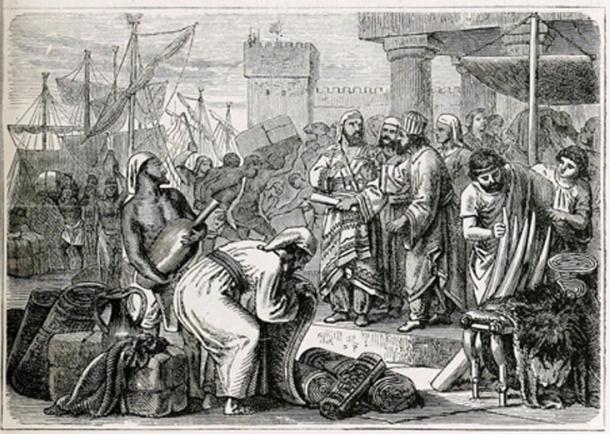
The Phoenicians flourished as marine merchants. (Baddu676 / Public Domain)
The Phoenicians flourished as marine merchants. (Baddu676 / Public Domain )
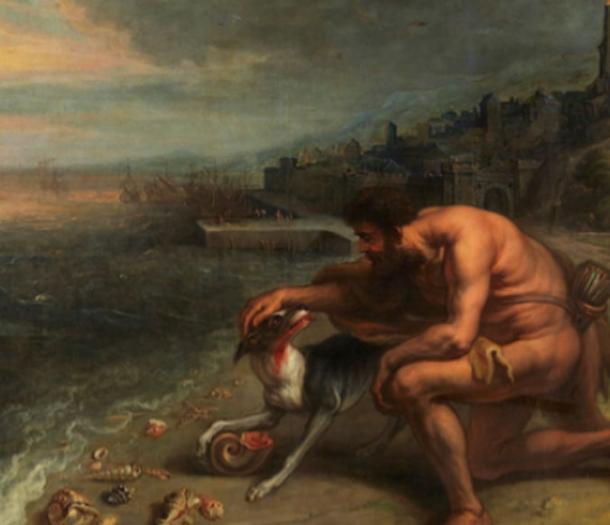
As mentioned before, the Greek ‘Phoiniki’ is associated with the dye known as Tyrian purple, which was traded by the Phoenicians. Indeed, this was one of the best-known products of Phoenicia. Tyrian purple was a highly-prized dye that was made using several species of sea snails belonging to the Muricidae family (commonly known as murex snails). One legend states that it was the Greek hero Hercules who discovered this dye. According to this tale, Hercules was strolling along the beach with a nymph, Tyrus, and his dog. Hercules’ dog came across a murex shell and devoured it. When the dog returned to its master its mouth was stained a brilliant purple.

Tyrus found the color so attractive that she requested from Hercules a robe of the of the same color as the price for her hand in marriage. Hercules obliged and gathered enough murex snails to produce the dye necessary to color Tyrus’ robe. In reality, however, Tyrian purple was discovered by the Phoenician. Although nobody is certain today as to how the dye’s discovery was made, it is entirely possible that it was accidental, similar to the Hercules story.
The discovery of Tyrian purple, which was made famous by the Phoenicians. (Lomojo / Public Domain)
The discovery of Tyrian purple, which was made famous by the Phoenicians. (Lomojo / Public Domain )
Tyrian purple was not the only trade object that the Phoenicians were famous for. Glass was another valuable product that the Phoenicians exported to the rest of the Mediterranean. Glass was already being produced by other civilizations including the Mesopotamians and Egyptians. The glass produced by these civilizations was colored and it is speculated that the Phoenicians were the first ones to produce transparent glass.

Yet another produce of Phoenicia was cedar wood, which the region is famous for, as far back as the Mesopotamian period. One of the main consumers of cedar wood during the 1 st millennium BC was Egypt, as the demand for wood by the Egyptians was greater than the local supply. Therefore, cedar wood was imported into Egypt from Phoenicia. During the 14 th century BC, for instance, the Phoenicians paid tribute to Egypt by offering cedar wood, as attested in the Amarna Letters .
The fame of the cedar wood from Phoenicia is also seen in the Story of Wenamun . In this Egyptian tale, Wenamun, a priest from the Amun Temple in Karnak sets off in a Phoenician ship to Byblos to purchase timber for the construction of a solar boat.
As superb seafarers, the Phoenician merchants need not rely solely on the goods locally produced in Phoenicia. They were more than capable of traveling to the far corners of the Mediterranean to obtain resources that they did not have back home. The most important of these were precious metals – tin and silver from Spain (and perhaps as far as Cornwall in England) and copper from Cyprus.
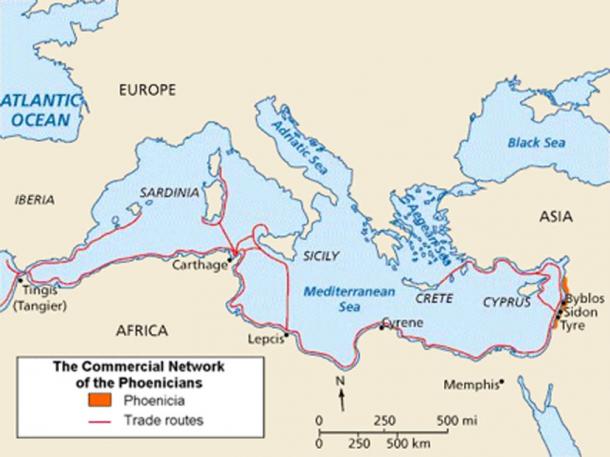
Colonies were set up along the trade routes in order to facilitate the journey of the Phoenician merchants. Moreover, Phoenicia is situated in a geographically strategic position that allowed it to further increase its wealth from trade.
The land of the Phoenicians is located between Mesopotamia in the east and Egypt and Arabia in the south / southwest. Trade routes between these two areas of the ancient world had to pass through Phoenicia thereby enriching the Phoenicians even further.
Map of Phoenicia and its Mediterranean trade routes. (Ras67 / CC BY-SA 3.0)
Map of Phoenicia and its Mediterranean trade routes. (Ras67 / CC BY-SA 3.0 )
We do not know to whether the Phoenicians had a shared identity and if they considered themselves as a single nation. Nevertheless, we do know that they established city states which were politically independent.
The rise of these Phoenician city states occurred around 12th / 11th centuries BC. Around this time, the old powers that dominated the region, i.e. the Egyptians and the Hittites , had either been weakened or were destroyed. For instance, the arrival of the Sea Peoples led to the decline of the New Kingdom in Egypt, while the Hittite Empire was breaking up around the same time.
The Phoenicians seized the opportunity to fill the power vacuum left behind by these empires by establishing their own city states. It seems that each city state was ruled by a monarch, whose power was limited by a powerful oligarchy.
In addition, there is no evidence that the cities banded together into a federation. Instead, they operated independently. Among the most notable Phoenician city states were Tyre, Sidon, and Byblos.
Byblos (known today in Arabic as Jbail) is located about 30 kilometers (20 miles) to the north of modern day Beirut. Its history stretches way back before its rise as a powerful Phoenician city state during the 12th century BC.
Byblos is considered to be one of the oldest continuously inhabited cities in the world and according to the archaeological evidence was settled by human beings as early as the Neolithic period. By the 4th millennium BC Byblos had grown into an extensive settlement. Byblos became the main harbor from which cedar wood was exported to Egypt. As a result of this, the city developed into an important trade center.
Byblos became an Egyptian dependency during the first half of the 2nd millennium BC and maintained close ties with Egypt in the following centuries. With the decline and subsequent collapse of the Egyptian New Kingdom during the 11th century BC, Byblos became the leading city state in Phoenicia.
By around 1000 BC, however, Byblos was eclipsed by two other independent Phoenician city states, Sidon and Tyre. Like Byblos, Sidon (known today in Arabic as Saida) was already an ancient city by the time it became an independent city state.
Sidon was established during the 3rd millennium BC and prospered in the following millennium as a result of trade. On the other hand, Tyre (known today in Arabic as Sur) was probably originally founded as a colony of Sidon. Like Byblos and Sidon, Tyre too became an independent city state when the Egyptians lost their grip over that region.
In time, Tyre surpassed Sidon as the most important Phoenician city state as it traded and established its own colonies in other parts of the Mediterranean. According to tradition, the famous city of Carthage was established as a colony of Tyre in 814 BC.
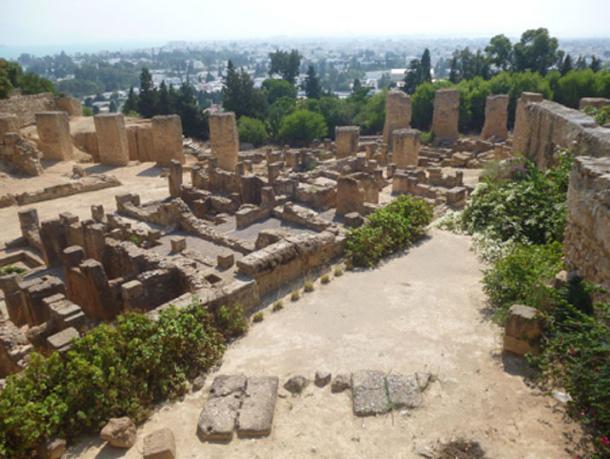
Archaeological site of Carthage, city established by the Phoenicians. (Eric00000007 / CC BY-SA 3.0)
Archaeological site of Carthage, city established by the Phoenicians. (Eric00000007 / CC BY-SA 3.0 )
Both Sidon and Tyre are also mentioned frequently in the Old Testament. For instance, the king of Tyre, Hiram, is recorded as providing Solomon the materials required for building the temple in Jerusalem.
The Phoenician city states were not able to hold on to their independence for long. The wealth of these city states must have attracted the attention of foreign powers. During the 8 th and 7 th centuries BC, the Phoenician city states came under the rule of the Neo-Assyrian Empire.
In 538 BC, Phoenicia was conquered by Cyrus the Great and came under Persian rule. Although the Phoenicians had lost their independence their cities continued to flourish.
Due to their expertise in seafaring, the Phoenicians supplied ships for the Persian kings. Persian rule over Phoenicia ended during the 4th century BC, when the region fell to Alexander the Great .
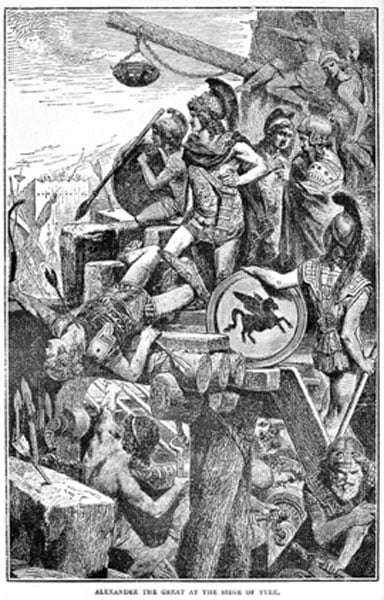
One of the major battles of Alexander’s campaign against the Persian Empire was the Siege of Tyre, which occurred in 332 BC. As the naval base of the Persians, Alexander knew that it would be unwise to leave it in the hands of the enemy as he continued his campaign southwards. He was also aware that Tyre would not fall so easily, as it was situated on an island off the mainland and was heavily fortified.
Therefore, he requested permission to offer sacrifices at the Temple of Melqart, the Phoenician god identified with the Greek hero Heracles, in the hopes that he would be allowed to enter the city. Alexander’s request was rejected, so he sent heralds to issue an ultimatum to the Tyrians – surrender or be conquered. In response, the Tyrians killed the heralds and threw them off the city walls.
Alexander the Great at the Siege of Tyre attacking the Phoenicians. (पाटलिपुत्र / Public Domain)
Alexander the Great at the Siege of Tyre attacking the Phoenicians. ( पाटलिपुत्र / Public Domain )
Enraged by the Tyrian’s defiance, Alexander proceeded to besiege the city. Due to the lack of a naval force the Macedonians were unable to assault the city directly. Instead, Alexander’s engineers began building a causeway to connect the island to the mainland. The Tyrians in turn sought to hamper the construction of the causeway, which was successful, until the arrival of a fleet of ships from Cyprus, as well as those that defected to Alexander from the Persians.
Eventually, the causeway was completed, and the Macedonians stormed and captured the city. The entire siege lasted seven months. Still furious with the Tyrians, Alexander executed about 10,000 of the city’s inhabitants, while another 30,000 were sold into slavery.
In the years following the death of Alexander the Great, Phoenicia was one of the regions fought over by the Seleucids and the Ptolemies, two of Alexander’s successors. During this period, the Phoenicians were gradually Hellenized, and their original identity was slowly being replaced. Finally, Phoenicia was incorporated by Pompey as part of the Roman province of Syria in 65 BC.
Although the Phoenicians disappeared from the pages of history, they are still remembered today as expert seafarers and merchants. This reputation, however, pales in comparison to the greatest contribution made by the Phoenicians to the modern world – the alphabet.
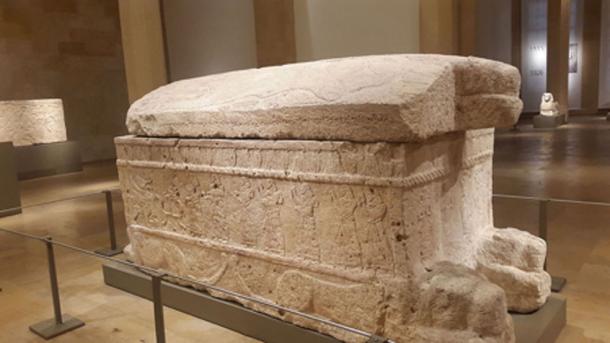
Like much of the Middle East during that time, the Phoenicians used a script known as cuneiform which originated in Mesopotamia. By around 1200 BC the Phoenicians had developed their own script. The earliest known example of the Phoenician script is found on the Sarcophagus of Ahiram, which was discovered in Byblos.
The Phoenician alphabet was later adopted by the Greeks who kept some characters while removing others. The Greek alphabet was in turn adopted by the Romans resulting in its spread all across Europe. Additionally, the Phoenician alphabet is considered to be the basis of other Middle Eastern, as well as Indian alphabets, either directly or indirectly.
Sarcophagus of Ahiram with Phoenician writing. (Emnamizouni / CC BY-SA 4.0)
Sarcophagus of Ahiram with Phoenician writing. (Emnamizouni / CC BY-SA 4.0 )
Top image: Phoenician stone sculpture ( disq / Adobe Stock)
By Wu Mingren
Aramco Services Company. 1960. Tyrian Purple. [Online] Available at: https://archive.aramcoworld.com/issue/196007/tyrian.purple.htm
Hickman, K. 2017. Wars of Alexander the Great: Siege of Tyre. [Online] Available at: https://www.thoughtco.com/alexander-the-great-siege-of-tyre-2360867
Hunt, P. 2019. Carthage. [Online] Available at: https://www.britannica.com/place/Carthage-ancient-city-Tunisia
New World Encyclopedia. 2019. Phoenician Civilization. [Online] Available at: https://www.newworldencyclopedia.org/entry/Phoenician_Civilization
Schumm, L. 2018. Who created the first alphabet?. [Online] Available at: https://www.history.com/news/who-created-the-first-alphabet
The Editors of Encyclopaedia Britannica. 1998. Ghassulian culture. [Online] Available at: https://www.britannica.com/topic/Ghassulian-culture
The Editors of Encyclopaedia Britannica. 2007. Byblos. [Online] Available at: https://www.britannica.com/place/Byblos
The Editors of Encyclopaedia Britannica. 2014. Sidon. [Online] Available at: https://www.britannica.com/place/Sidon
The Editors of Encyclopaedia Britannica. 2015. Tyre. [Online] Available at: https://www.britannica.com/place/Tyre
The Editors of Encyclopaedia Britannica. 2019. Phoenicia. [Online] Available at: https://www.britannica.com/place/Phoenicia
The Metropolitan Museum of Art. 2004. The Phoenicians (1500–300 B.C.). [Online] Available at: https://www.metmuseum.org/toah/hd/phoe/hd_phoe.htm
TimeMaps Ltd. 2019. The Phoenicians. [Online] Available at: https://www.timemaps.com/civilizations/phoenicians/
Waterfield, R. (trans.). 1998. Herodotus’ The Histories . Oxford: Oxford University Press.
www.touregypt.net. 2019. Wenamen’s Journey. [Online] Available at: http://www.touregypt.net/wenamensjourney.htm
Wu Mingren (‘Dhwty’) has a Bachelor of Arts in Ancient History and Archaeology. Although his primary interest is in the ancient civilizations of the Near East, he is also interested in other geographical regions, as well as other time periods…. Read More
Hi All,
Wow, The Bible just got confirmed since Canaan The Land of The Canaanites is mentioned numerous Time’s through out Genesis & Jubilees.
It was exciting too read about Tyre & Sidon.
In 1st King’s of The Bible Sidon is The Kingdom Queen Jezebel King Ahab’s Wife hailed from a devout worshipers of the gods in her country Baal & Ashera; which was why Ahab shouldn’t have married her to begin with, but that’s a story for another Time.
Which makes Jezebel and her people Phonecians.
I do know in The Gospel’s such as Matthew & Luke Jesus for tells that it would be more Bearable for The People of Sodom, Sidon, & Tyre on The Day of Judgment than for this generation.
I was under the mistaken impression that The Canaanites were all extinct; until, I saw a Jeopardy Episode back when Alex Trebek was still with Us an learned that The Canaanites did still exist They all live in present Day Lebanon.
My memory serves from Sunday School then later Sabbath School The Canaanites are Ancestor’s of A Man named Canaan.
The significance Canaan was Ham’s youngest Son and the Subject of Biblical Scholarly Debate whether A Drunken Noah curse only affected Canaan are all of Canaans sibling’s. The Biblical Reference was used to justify The African Enslavement/Colonialism of Africa.
Clearly those people weren’t reading The Scriptures Right because they always say Ham got cursed, Ham didn’t get cursed Canaan and his Sibling’s got Cursed.
For the record Ham & his Wife couldn’t be Cursed because when they exited The Ark and made the sacrifice too God in response God Blessed Them being Blessed meant Ham was untouchable with Noah’s Curse so that’s why Canaan wound up getting Cursed.
An yet as I’ve stated Earlier Those same Canaanites thrive in Lebanon Today.
That’s all I wish too share in this discussion about The Phonecians so until next Discussion regarding another Subject or Topic everyone Goodbye!
Hi All,
Wow, The Bible just got confirmed since Canaan The Land of The Canaanites is mentioned numerous Time’s through out Genesis & Jubilees.
It was exciting too read about Tyre & Sidon.
In 1st King’s of The Bible Sidon is The Kingdom Queen Jezebel King Ahab’s Wife hailed from a devout worshipers of the gods in her country Baal & Ashera; which was why Ahab shouldn’t have married her to begin with, but that’s a story for another Time.
Which makes Jezebel and her people Phonecians.
I do know in The Gospel’s such as Matthew & Luke Jesus for tells that it would be more Bearable for The People of Sodom, Sidon, & Tyre on The Day of Judgment than for this generation.
I was under the mistaken impression that The Canaanites were all extinct; until, I saw a Jeopardy Episode back when Alex Trebek was still with Us an learned that The Canaanites did still exist They all live in present Day Lebanon.
My memory serves from Sunday School then later Sabbath School The Canaanites are Ancestor’s of A Man named Canaan.
The significance Canaan was Ham’s youngest Son and the Subject of Biblical Scholarly Debate whether A Drunken Noah curse only affected Canaan are all of Canaans sibling’s. The Biblical Reference was used to justify The African Enslavement/Colonialism of Africa.
Clearly those people weren’t reading The Scriptures Right because they always say Ham got cursed, Ham didn’t get cursed Canaan and his Sibling’s got Cursed.
For the record Ham & his Wife couldn’t be Cursed because when they exited The Ark and made the sacrifice too God in response God Blessed Them being Blessed meant Ham was untouchable with Noah’s Curse so that’s why Canaan wound up getting Cursed.
An yet as I’ve stated Earlier Those same Canaanites thrive in Lebanon Today.
That’s all I wish too share in this discussion about The Phonecians so until next Discussion regarding another Subject or Topic everyone Goodbye!
Hi All,
Wow, The Bible just got confirmed since Canaan The Land of The Canaanites is mentioned numerous Time’s through out Genesis & Jubilees.
It was exciting too read about Tyre & Sidon.
In 1st King’s of The Bible Sidon is The Kingdom Queen Jezebel King Ahab’s Wife hailed from a devout worshipers of the gods in her country Baal & Ashera; which was why Ahab shouldn’t have married her to begin with, but that’s a story for another Time.
Which makes Jezebel and her people Phonecians.
I do know in The Gospel’s such as Matthew & Luke Jesus for tells that it would be more Bearable for The People of Sodom, Sidon, & Tyre on The Day of Judgment than for this generation.
I was under the mistaken impression that The Canaanites were all extinct; until, I saw a Jeopardy Episode back when Alex Trebek was still with Us an learned that The Canaanites did still exist They all live in present Day Lebanon.
My memory serves from Sunday School then later Sabbath School The Canaanites are Ancestor’s of A Man named Canaan.
The significance Canaan was Ham’s youngest Son and the Subject of Biblical Scholarly Debate whether A Drunken Noah curse only affected Canaan are all of Canaans sibling’s. The Biblical Reference was used to justify The African Enslavement/Colonialism of Africa.
Clearly those people weren’t reading The Scriptures Right because they always say Ham got cursed, Ham didn’t get cursed Canaan and his Sibling’s got Cursed.
For the record Ham & his Wife couldn’t be Cursed because when they exited The Ark and made the sacrifice too God in response God Blessed Them being Blessed meant Ham was untouchable with Noah’s Curse so that’s why Canaan wound up getting Cursed.
An yet as I’ve stated Earlier Those same Canaanites thrive in Lebanon Today.
That’s all I wish too share in this discussion about The Phonecians so until next Discussion regarding another Subject or Topic everyone Goodbye!
Hi All,
Wow, The Bible just got confirmed since Canaan The Land of The Canaanites is mentioned numerous Time’s through out Genesis & Jubilees.
It was exciting too read about Tyre & Sidon.
In 1st King’s of The Bible Sidon is The Kingdom Queen Jezebel King Ahab’s Wife hailed from a devout worshipers of the gods in her country Baal & Ashera; which was why Ahab shouldn’t have married her to begin with, but that’s a story for another Time.
Which makes Jezebel and her people Phonecians.
I do know in The Gospel’s such as Matthew & Luke Jesus for tells that it would be more Bearable for The People of Sodom, Sidon, & Tyre on The Day of Judgment than for this generation.
I was under the mistaken impression that The Canaanites were all extinct; until, I saw a Jeopardy Episode back when Alex Trebek was still with Us an learned that The Canaanites did still exist They all live in present Day Lebanon.
My memory serves from Sunday School then later Sabbath School The Canaanites are Ancestor’s of A Man named Canaan.
The significance Canaan was Ham’s youngest Son and the Subject of Biblical Scholarly Debate whether A Drunken Noah curse only affected Canaan are all of Canaans sibling’s. The Biblical Reference was used to justify The African Enslavement/Colonialism of Africa.
Clearly those people weren’t reading The Scriptures Right because they always say Ham got cursed, Ham didn’t get cursed Canaan and his Sibling’s got Cursed.
For the record Ham & his Wife couldn’t be Cursed because when they exited The Ark and made the sacrifice too God in response God Blessed Them being Blessed meant Ham was untouchable with Noah’s Curse so that’s why Canaan wound up getting Cursed.
An yet as I’ve stated Earlier Those same Canaanites thrive in Lebanon Today.
That’s all I wish too share in this discussion about The Phonecians so until next Discussion regarding another Subject or Topic everyone Goodbye!
Evidence suggests that the ancient Greek people, in a generic sense, were the aboriginals/Neanderthal who probably had already carved out the catacombs and erected much if not all of the megalith stone cultural centers that were already in ruin by the time the Sumerians arrived (and began building over them with mud bricks).  Of course we know of Plato’s knowledge of Atlantis, probably via oral history, as nothing was left of it by his time.  Most likely it was the place now called the Richat Structure, which would have been a nice estuary just prior to the sudden onset of the Ice Age around 120,000 years ago.  That’s the place where the maritime culture of the Atlantic/Med would have evolved (although now a barren-dry desert that might just need some digging).  The Atlanteans would likely have had a written language, probably similar to ancient Greek/Doric.  But the archaeological problem, other than lack of interest in digging up the Richat Structure valley, is the gap between before the Ice Age and when the ruins were resettled by survivors of that global calamity and the new arrivals, e.g.,, children of the Sumerians (Persian types), the self-described black-headed people, said to have come to Earth from another planet, probably with their own written language (Semitic – as ancient Greeks called them, semi-man, or half-breeds, from bearing children from aboriginal women).  Lot of diversion and deception in the field, concealing what looks to be unmentionable ugliness/tragedy/crime that fell upon that earlier (ancient Greek) civilization.  
Nobody gets paid to tell the truth.
Ancient Origins Store
Anatolia Turkey
IRAN Expedition
SUDAN Expedition
All Expeditions
Ancient Origins DNA
Natural History
Ancient Origins Magazine
Historic Mysteries
 
 
Ancient Origins has been quoted by:
Ancient Origins Quotations
At Ancient Origins, we believe that one of the most important fields of knowledge we can pursue as human beings is our beginnings. And while some people may seem content with the story as it stands, our view is that there exist countless mysteries, scientific anomalies and surprising artifacts that have yet to be discovered and explained.
The goal of Ancient Origins is to highlight recent archaeological discoveries, peer-reviewed academic research and evidence, as well as offering alternative viewpoints and explanations of science, archaeology, mythology, religion and history around the globe.
We’re the only Pop Archaeology site combining scientific research with out-of-the-box perspectives.
By bringing together top experts and authors, this archaeology website explores lost civilizations, examines sacred writings, tours ancient places, investigates ancient discoveries and questions mysterious happenings. Our open community is dedicated to digging into the origins of our species on planet earth, and question wherever the discoveries might take us. We seek to retell the story of our beginnings. 
Ancient Origins © 2013 – 2022
Disclaimer – Terms of PublicationPrivacy Policy & CookiesAdvertising Policy – Submissions We Give BackContact us

source

WHO WERE THE PHOENICIANS? – Life & Culture – Haaretz

KIP – Kotarim International Publishing, Ltd
It is universally accepted today that the Phoenicians were a nation which had settled on the Mediterranean coast, along a narrow strip of land bordered by Aradus to the north, Mount Lebanon to the east, and Mount Carmel to the south. The city of Jaffa is sometimes mentioned as the southern border, and the Eleutherus river (Nehar el–Kebir) as the northern one. Plinymentions Jaffa as “Jaffa the Phoenician” though he designates the city of Dor as the border between Phoenicia and Judea. Raymond Weill, relying on various sources, infers that the term Phoenicia implied at first a vast section of the Aegeo–Asiatic world, and that only in the course of centuries it became restricted to the above–mentioned narrow coastal strip. For Weill this puzzling fact remains inexplicable. According to Herodotus (II, 84) “these Phoenicians dwelt in old time, as they themselves say, by the Red Sea”This quotation from Herodotus was taken by many scholars to mean they came from the region surrounding the Persian Gulfwhile others thought they were from the Erythrean region. Strabo (I, II, 35; XVI, 27) refers with astonishment to the claim of the inhabitants of the Persian Gulf that two cities in their region are named Tyros and Aradus, whereas Plinystates that the name is not Tyros but Tylos.
With respect to political and geographical relations, Phoenicia held a foremost position in the history of the ancient world. The Phoenicians were known as brave and courageous merchants and seafarers. They were the first to venture great distances from shore and to navigate the open seas aided by the north star as guide. In their travels they gained the Atlantic Ocean, and were the first to reach the British Isles. Herodotus states (IV, 42) that Phoenician seafarers were the first to circumnavigate the African continent. Through their constant travelling, the Phoenicians expanded their commercial ties with many countries and served as link between east and west. Another consequence of their travels was the founding of many settlements, especially in the Mediterranean Basin. The army of one of these – Carthage – nearly vanquished Rome.
The Phoenicians had an enormous influence on the ancient world, particularly upon the Greeks, in architecture, religion, language, and other spheres. Plinyascribes to the Phoenicians the invention of the glass industry. Whether this statement is accurate or not, there is no doubt that they raised the art of glass–making to a high degree of perfection. He also ascribes to them the invention of astronomy, navigation and military strategy. From the Phoenicians the Greeks received their system of weights and measures. However, the most important invention attributed to themis that of phonetic writing which was and still is, the main basis and cause for the development and advancement of the human race.
The term “Phoenicians” appears in later centuries – first and foremost in early Greek literature. Homer, the ancient Greek poet (c. 1000 B.C.) is the earliest source mentioning “Phoenicians (Phoinikes – Phoiniké) from Tyre and Sidon” and telling of “Sidon which is in Phoenicia”. Nevertheless, in epigraphic inscriptions from that part of the world where Phoenicia is supposed to have existed, no such name appears. The Bible refers to the inhabitants of this area as Tyrians and Sidonians, whereas in the Amarna letters we read of Sidon or Canaan, although the latter is used to denote a general term for the whole area. In Egyptian inscriptions, the names “Kharu” or “Retenu” are employed to designate the region of Phoenicia and Israel. It should be noted that in certain Egyptian texts from the 3rd millenium B. C., the name “Pnhu” appears which Seth finds similar to the Greek “Phoinikes”, and he identifies it with the Phoenicians.
It should be emphasised that in ancient Greek literature, including Homer, despite the use of the term Phoenicians, the term Sidonians is more generally employed. The interpretation of “Phoenicia” as identical with Canaan appears only in later periods (Stephen of Byzantium, Sanchoniathon) to be followed accordingly by the Church Fathers who identified Canaan with Phoenicia. Hecateustells us that “Phoenicia was formerly called Chna” (Canaan), However Philo Bybliusmentions in his Mythology “Chna who was afterwards called Phoinix”. This informs us that the name Canaan was changed to Phoenicia. Yet today it is customary to see the terms Phoenicians, Sidonians, and Canaanites as a single identity, and therefore interchangeable; which has produced the tendency to designate as “Phoenicians” the inhabitants of the region even in periods prior to the appearance of this name in history. To cite Albright, “The word ‘Canaanite’ is historically, geographically, and culturally synonymous with ‘Phoenicia'”.
Who, therefore, were these people who settled in the region of Tyre and Sidon?
The Bible classifies the inhabitants of the world into three ethnic groups: Shem, Ham and Japhet,a division which is still in use with the modification that instead of the Japhet group we speak of the Indo–European group. Since the Bible associates the Sidonians with Canaan the son of Ham, they are still linked nowadays with the Canaanite race. However, the linguistic and cultural characteristics of the nation that inhabited the region of Sidon, as revealed by archaeological findings, are those of a Semitic people. This evidence induced scholars to accept the biblical division only in part: namely, that the Phoenicians were Canaanites by race, yet were not of Hamitic, but rather of Semitic origin This paradoxical explanation is the general belief today. In support, the analogy is made with today’s Afro–American descendants, with their English language culture. Interestingly, Autran claims their origin to have been entirely different, calling them Aegeo–Asiatics. Perrot,while trying to classify the Phoenicians, states: “…relying upon the genealogical table in the tenth chapter of Genesis some have supposed them to belong to the stem of Cush so they would be cousins of the Egyptians, like the Canaanites who according to the same genealogy were also sons of Ham. But, on the other hand, since the Phoenician inscriptions have been deciphered it has been recognised that the Phoenician and Hebrew languages resembled each other very narrowly – so narrowly – that they might almost be called two dialects of one tongue. If this be so, ought we not rather to connect the Phoenicians with the great Semitic race of which the Hebrews are the most illustrious representation. We cannot say how close the relationship may have been, but in any case the Phoenicians must have been much more nearly connected with the Hebrews than with the Egyptians and other nations whom we know as Cushites and Hamites”.
The principal object of this book is to try, in the light of sources known to us, to trace the course of events in the area of Sidon, (known to be in Phoenicia), from the remotest periods in time, and by so doing to provide an answer to the question: Who were the people that dwelt in that region? In other words, who were the people whom the Greeks called “Phoenicians”?
The sources from which historical investigators derived their knowledge of Phoenician history can roughly be divided into two: epigraphic and archaeological. In the main we will discuss the epigraphic sources, and then go to examine how far the archaeological findings are in conformity with the conclusions deriving from these sources.
Until the discovery of the Tell el–Amarna and Ras Shamra tablets our main source for the knowledge about the Phoenicians were the Latin and Greek literatures. But these are not to be considered a primary source, since they originated in later periods: Homer, c. 1000 B. C.; Herodotus between c. 480–425 B. C.; Strabo, 50 B. C.; Josephus and Diodorus Siculus in the first decade A. C. etc.
The most ancient epigraphic sources in our possession today are the Ras– Shamra tablets, el–Amarna tablets, and the Bible. Of these, only the last two refer to political events, therefore we shall try to extract information from these two sources about the region of Sidon.
The book is now available on:
Automatic approval of subscriber comments.
From $1 for the first month

source

The stories behind the letters of our alphabet – New York Post


Thanks for contacting us. We've received your submission.
G’s that look like I’s, F’s that sound like “Waw,” and Q’s that look like monkeys — man, was our alphabet a mess.
That’s because many of our letters began as Egyptian hieroglyph symbols 4,000 years ago, with a hodgepodge of Semitic, Phoenician, Greek and Roman influences thrown in.
It would take centuries, and the dropping of more than a few letters along the way, before our alphabet was born. By year 1011, the order that we know today was largely in place — excluding “J,” “U,” “W” — but there were 29 letters, including the ampersand.
The alphabet we know today takes its modern 26-letter shape in the 16th century.
Author Michael Rosen devotes 400-plus pages to topsy-turvy history of our letters in his entertaining “Alphabetical: How Every Letter Tells A Story” (Counterpoint), dedicating a chapter to each of the 26 letters. Here’s a brief look.
Illustrations by Leah Tiscione

Turn the “A” upside down and you’ll have a good sense of its original shape and meaning when it was introduced around 1800 BC. Resembling an animal’s head with antlers or horns, the original meaning of the letter in ancient Semitic was “ox.”

Flip “B” on its belly and you see a home — complete with a door, a room and a roof. Now you have some idea of why 4,000 years ago in Egypt, “B” (which sounded like our “h”) was a hieroglyph that meant “shelter.”

The first “C” shape emerged in Phoenician and stood for a hunter’s stick or boomerang. The Greeks renamed it “gamma” and when they switched to reading from right to left to left to right in 500 BC, they flipped the shape. As the letter spread to Italy, it took on a more crescent shape, and the C as we know it today was born.

Around 800 BC, Phoenicians began to use a “dalet” — or a rough triangle facing left — which translated to door. The Greeks adopted it and renamed it “delta.” The Romans later added serifs and varied the thickness of the lines, softening one side into a semicircle.

The “E” of 3,800 years ago, pronounced “h” in Semitic, resembled a stick with two arms and a leg meant to signify a human form. The Greeks flipped it around in 700 BC and changed the sound to “ee.”

The “F” of Phoenician times resembled a “Y” and sounded like “waw.” The ancient Greeks changed it to “digamma” and tipped the “Y” over to look like a drunk version of our “F.” The Romans regulated the writing of the letter centuries later, drawing the cross lines at firm geometric right angles, also giving it the “fff” sound.

Today’s “G” derives from the Greek letter “zeta,” a letter that looks like our “I” but was pronounced as a “zzz.” Around 250 BC, Romans altered the shape of this strange letter to look more like an “E” without the middle horizontal arm and then applied the “g” sound because they didn’t need the “z” sound in Latin. Over time, the crescent curved.

Based on the Egyptian hieroglyph of a fence, it’s one of the most controversial letters in the English language. The breathy sound associated with the letter made academics argue that the letter was unnecessary — and many Latin and British scholars began dropping the “H” in 500 AD. Despite the controversy, “H” secured a spot in our alphabet.

Around 1000 BC, the letter “I” was “yod,” meaning arm and hand. The Greeks adopted the letter as “iota” changing it to a vertical squiggle. By 700 BC, “I” became the straight line we use today.

“I” was a popular letter and often a stand-in for “j” sounds. The red-headed stepchild of our alphabet, “J” was only introduced in standardized spelling in the 15th century by the Spanish and only appeared consistently in print around 1640.

What appeared to be an outstretched hand with one finger and a thumb visible appeared in Egyptian hieroglyphs around 2000 BC. The ancient Semites called it a “kaph,” meaning “palm of the hand,” which sounded like our “K.” Around 800 BC, the Greeks reversed it and took it on as their own “kappa.”

A hook-shaped letter, referred to as “El,” meaning “God” emerged in ancient Semitic inscriptions around 1800 BC. The Phoenicians straightened out the hook, reversed its position, and called it “lamed” (“lah-med”), meaning a cattle prod. Again the Greeks flipped the letter and renamed it “lamda.” The Romans straightened the bottom leg into a right angle.

Four-thousand years ago, Egyptians drew a vertical wavy line with five peaks to denote “water.” The Semites reduced the number of waves to three in 1800 BC; the Phoenicians continued the trend by removing one more wave. By 800 BC, the peaks became zigzags and the structure was made horizontal — our “M” in sound and appearance.

Around the same time as “M,” “N” was emerging in Egypt with a small ripple on top and a larger one below. The word translated to “snake” or “cobra.” Ancient Semites gave it the sound “n,” meaning fish. By around 1000 BC, the sign contained just one wave and was named “nu” by the Greeks.

“O” starts its life on Egyptian hieroglyphs (around the time as “M” and “N”) as “eye.” Semites called it “ayin,” but with a guttural sound that sounds like “ch” (think Hebrew name Chaim). The Phoenicians reduced the eye to just the outline of a pupil, our “O.”

An inverted “V”-shape appears in early Semitic language 3,800 years ago, sounding like “pe” and meaning “mouth.” The Phoenicians adapted it to a diagonal hook shape at the top. The Romans closed the loop, and flipped it right, by 200 BC.

Around 1000 BC, “Q,” which sounded like “qoph,” either meant ”monkey” or a “ball of wool.” According to Rosen, academics are still split. “Q” was then a circle with a vertical line through it. A “Q” that we’d recognize appeared in Roman inscriptions in 520 BC — it was also then that the “u after q” rule was invented.

“R” first appears in ancient Semitic in the form of a profile of a human. Pronounced “resh” it translated to (no surprise) “head.” The Romans flipped it to face right and added a tail, “probably to distinguish it from ‘P’,” writes Rosen.

Early “S’s” appeared 3,600 years ago as a horizontal, curvy “W” shape, meant to denote an archer’s bow. Phoenicians added an angularity that looks more like our “W’s” At this stage it was known as “shin” meaning “tooth.” The early Greeks rotated it to the vertical and called it “sigma” with the “s” sound — and the Romans flipped it.

“T” in its modern, lower-case form, is found all over ancient Semitic inscriptions. By 1000 BC, the Phoenicians referred to it as “taw,” meaning “mark,” with our current “tee” sound. The Greeks named it “tau” and added a cross stroke at the top to differentiate it from “X.”

There’s a lot of confusion among letters “U,” “V” and “W.” According to Rosen, the Phoenicians began using a letter that looked like our “Y” around 1000 BC. They called it “waw” meaning “peg.” The Greeks adopted this in 700 BC and called it “upsilon.”

The Romans did not differentiate between “V” and “U” sounds — so Venus was actually pronounced “Weenus.” Even Shakespeare used “U’s” in place of “V’s” in his plays and poems. Capital “V’s” at the start of words started to appear in the 1400s.

During the Middle Ages, Charlemagne’s scribes placed two “U’s” side by side with a space between (as in literally “double U”), a new letter that sounded like a “V.” It wasn’t until around 1700 that W as a unique letter (not two “U’s” or two “V’s” placed side-by-side) emerged in printing presses across Europe. In French, this letter is still referred to as “double V.”

The ancient Greeks had a letter “ksi” which sounded like our “X.” Lower case “x’s” arrive via handwritten manuscripts of early medieval times and the Italian printers of the late 15th century.

The original “Y” entered the alphabet as “upsilon” or our “U.” Around 100 AD Romans added “Y” to their alphabet, usually to denote something of Greek origins.

“Z” might be the last letter of the alphabet, but it’s an elder. Three-thousand years ago the Phoenicians used a letter called “zayin,” meaning “ax.” It looked like an uppercase “I” with top and bottom serifs. The Greeks adopted it as “zeta” around 800 BC, when it evolved into our modern “Z” shape (and also led to the creation of our “G”) with the sound of “dz.” The letter fell into disuse for several centuries, until the Norman French arrived with words that used the “Z” sound.
It took thousands of years to establish our 26-letter alphabet. As we formed our modern language, we lost a few letters, including:
Thorn: þ
This letter — which was pronounced “th” as in “them” and translated to “the” — took the place of “ye” in place names like “Ye Olde Fishe and Chippe Shoppe.” Over time, as Gothic script was introduced to Old English, “Y” and “thorn” looked too similar — and one had to go.
Wynn: ƿ
Latin didn’t offer a letter with the “wah” sound popular to English speakers. Wynn filled the void, but not for long. Over time, it became popular to stick two double-“U’s” side-by-side to create the sound of wynn.
Yogh: Ȝ
The yogh sound entered during the Middle English to represent the “ch” sound (think: Bach). It disappeared thanks to the French printing presses, which decided to replace yogh with “gh.”
Ash: ӕ
You’ve seen it in medieval (when spelled mediaeval) or in aeon and aether. This is an example of Roman ligature, meaning the tying together of two letters, in this case “a” and “e.” Though it was dropped as a letter from English, it remains one in Danish, Norwegian and Icelandic.
Ethel: œ
Another Latin ligature, this is the combination of “o” and “e” that can be seen in words like “foetus” and “subpoena.” Now in most cases, we replace this letter with an e.
Ampersand: &
Though Rosen does not include this in his book, because he says “pedantically and fussily” that it’s a symbol, not a letter. But the ampersand was once considered part of the alphabet. In fact, that’s how it got its name. The end of the alphabet was “x, y, z and, per se, and.” That is, “in itself, and,” meaning the symbol for “and.” That became am-per-sand.

source

New Roman Temple Discovered in Ancient Phoenician City of Tyre – ARTnews

By Jesse Holth
A new Roman temple has been discovered by archaeologists in the ancient Phoenician city of Tyre, located off the coast of Lebanon. The joint excavation, led by María Eugenia Aubet (Pompeu Fabra University of Barcelona), Ali Badawi (General Directorate of Antiquities of Lebanon), and Francisco J. Núñez (Polish Centre of Mediterranean Archaeology, University of Warsaw), focused on the massive structure.
Two phases of construction have been identified, placing the temple in the early Roman period (about 31 B.C.E. to 193 C.E.) with a major modification in the late Roman period (about 284 C.E. to 476 C.E.). The temple is situated in the Tyre Acropolis, the highest point of the land mass, which Greek and Phoenician inscriptions describe as a sacred area. Researchers believe many cult-related rituals and worship activities would have taken place here.

Related Articles

“Its location on a podium in the most elevated area of the ancient island highlights this building’s particular status,” said Núñez in an email.
The rectangular building is east-west in orientation, with a vestibule flanked by two columns, and a podium on the other side. Temple walls were originally comprised of sandstone blocks, and the building stood on a platform made of limestone and sandstone. The 26-foot-high columns were made of Egyptian pink granite, and the stepped entryway was decorated with engraved slabs featuring geometric motifs.
“It is one of but a few buildings of this character found in Tyre to date,” Núñez wrote. “Our knowledge of Tyre in Antiquity, despite the great prominence of the city, is unfortunately quite limited.”
Researchers believe there may have been a subterranean chamber located south of the entrance. The exact object of veneration at the massive temple remains a mystery. “At least for now, the name of the deity worshipped in this building remains elusive to us,” wrote Núñez.
The porticoed street that descends from the temple intersects with a narrower street leading to a nearby shrine, with two rooms and a courtyard. This smaller structure is oriented north-south, with one room featuring an Egyptian relief that portrays the goddess Isis breastfeeding her son Horus as a child.

Tyre is one of the oldest continuously inhabited cities in the world, with a long history of settlement dating back to the 3rd millennium B.C.E. It has long been a significant port and trading center in the Mediterranean region. During the Bronze Age and Iron Age, around 1,200 B.C.E. to 868 B.C.E., it was an independent Phoenician city and a site of major economic importance, including industry, commerce, and crafts.Originally located on an offshore island, Tyre was connected to the mainland by a causeway built by Alexander the Great.
Buildings constructed over five millennia by various cultures have made Tyre a difficult archaeological site to investigate, with layers of occupation overlapping each other. “The superimposed architectural remains, along with natural catastrophes, the rise of the sea level, and the dynamic land development and public works in the recent decades efficiently obscured the character of ancient architecture,” Núñez said in a statement.
The area around the temple was severely damaged and reconstructed in the Early Byzantine era. The temple itself was dismantled and replaced by a large basilica, which was eventually destroyed along with other parts of the city during a tsunami in the 6th century C.E.
Work will continue at the site in 2022, with further investigations of the Roman temple and surrounding area. Researchers plan to determine whether a second monumental building, located to the north, is another temple.
The World's Premier Art Magazine since 1913. Subscribe today and save up to 29%!
Sign Up for our Newsletters
Get our latest stories in the feed of your favorite networks
We want to hear from you! Send us a tip using our anonymous form.
Subscribe to our newsletters below
ARTnews is a part of Penske Media Corporation. © 2022 Art Media, LLC. All Rights Reserved.

source