Marine archaeologist unearths evidence suggesting biblical king’s riches were based on voyages he funded with Phoenician allies
King Solomon is venerated in Judaism and Christianity for his wisdom and in Islam as a prophet, but the fabled ruler is one of the Bible’s great unsolved mysteries.
Archaeologists have struggled in vain to find conclusive proof that he actually existed. With no inscriptions or remnants of the magnificent palace and temple he is supposed to have built in Jerusalem 3,000 years ago, the Israelite king has sunk into the realm of myth.
Now British marine archaeologist Dr Sean Kingsley has amassed evidence showing that Solomon was not only a flesh-and-blood monarch but also the world’s first shipping magnate, who funded voyages carried out by his Phoenician allies in “history’s first special relationship”.
Over 10 years, Kingsley has carried out a maritime audit of “the Solomon question”. By extending the search beyond the Holy Land, across the Mediterranean to Spain and Sardinia, he found that archaeological evidence supports biblical descriptions of a partnership between Solomon, who “excelled all the kings of the earth in riches and in wisdom”, and the Phoenician king Hiram, who “supplied Solomon with cedar timber and gold, as much as he desired”.
Kingsley told the Observer: “I’ve spread a very wide net. That kind of maritime study has never been done before.”
He said: “For 100 years, archaeologists have scrutinised Jerusalem’s holy soils, the most excavated city in the world. Nothing definitive fits the book of Kings’ and Chronicles’ epic accounts of Solomon’s palace and temple. By exploring traces of ports, warehouses, industry and shipwrecks, new evidence shakes up the quest for truth.”
He explored Andalusian port towns from Mezquitilla to Málaga and found that the archaeological evidence reveals “a Phoenician coast”. He visited the site of the great mine of the ancient world, Rio Tinto – 70km inland from Huelva – which produced gold, silver, lead, copper and zinc – and where, crucially, he realised that old maps and historical accounts referred to a particular spot as Cerro Solomon or Solomon’s Hill.
One 17th-century account notes that Solomon’s Hill was previously called Solomon’s Castle, and another describes people being “sent there by King Solomon for gold and silver”.
At the site, archaeologists have found ancient mining tools, such as granite pestles and stone mortars used to crush minerals, and remnants of lead slag that held a high proportion of silver. Kingsley said that lead isotope analysis has shown that silver hoards excavated in Israel originally came from Iberia.
Recent digs in nearby Huelva have found evidence of the Israelites and Phoenicians, including elephant tusks, merchants’ shekel weights and pottery. The Near Eastern link can be dated as far back as 930BC, the end of Solomon’s reign, and Kingsley has concluded that Huelva is “the best fit for the capital of the biblical Tarshish”, the ancient source of imported metals, which archaeologists have “signposted wildly”, everywhere from southern Israel to the Red Sea, Ethiopia to Tunisia.
He was struck by texts and ruins that support a “far more conclusive candidate” in this area of the southern Iberian Peninsula, which was known in antiquity as Tartessos, a Greek derivation of Tarshish. A Phoenician script on a ninth-century BC stele found in Sardinia refers to the land of Tarshish, also proving its historical reality.
Kingsley, who has explored more than 350 shipwrecks in the past 30 years, will publish his research in the forthcoming spring issue of Wreckwatch magazine, the free journal for maritime archaeology, which he also edits.
Solomon is believed to have built the First Temple of Jerusalem on the Temple Mount. Kingsley writes that everything historians know about it comes from the Bible, including details such as its inner sanctum lined with pure gold: “Building cities, palaces and a flagship temple didn’t come cheap. Long-distance voyages to the lands of Ophir and Tarshish brought a river of gold, silver, precious stones and marble to the royal court.
“Neither Israel nor Lebanon could tap into local gold and silver resources. The biblical entrepreneurs were forced to look to the horizon. The land of Tarshish was a vital source for Solomon’s silver. As the Book of Ezekiel recorded: ‘Tarshish did business with you because of your great wealth of goods.’”
Kingsley added: “What turned up in southern Spain is undeniable. Phoenician signature finds, richly strewn from Rio Tinto to Málaga, leave no doubt that Near Eastern ships voyaged to what must have seemed the far side of the moon by 900BC.
“When I spotted in ancient accounts the name of the hill where silver was mined at Rio Tinto – Solomon’s Hill – I was stunned. Biblical history, archaeology and myth merged to reveal the long-sought land of Tarshish celebrated in the Old Testament.
“It looks like Solomon was wise in his maritime planning. He bankrolled the voyages from Jerusalem and let salty Phoenician sailors take all the risks at sea.”
The Complicated History of Religion and Archaeology – DISCOVER Magazine
The Temple Mount is one of the most popular destinations in the ancient city of Jerusalem. In Arabic, it’s known as Haram al-Sharif — "the Noble Sanctuary." Considered the holiest site in Judaism and third holiest in Islam, it is where, according to the Bible, King Solomon built the first temple for the Jews. It's also said to be the location where Abraham offered his son Isaac as a sacrifice, and where the Prophet Muhammad made his Miraculous Night Journey to the throne of God. The golden Dome of the Rock atop the Temple Mount commemorates that event, which is sacred in Islam.
While visiting such hallowed ground today, it's easy to forget that the Temple Mount’s significance maybe wouldn't be known without the archaeological excavations and discoveries that began more than 150 years ago.
Biblical archaeologists have long been motivated by their faith to explore the historicity of biblical events. Today, these researchers are trained in the field, but that wasn't always the case. "The first archaeological endeavors in the Holy Land were conducted not by archaeologists but by theologians, biblical scholars, and engineers primarily interested in locating places mentioned in the Bible," writes Eric Cline, in his book Biblical Archaeology: A Very Short Introduction.
Cline, an anthropology professor at George Washington University, credits an American minister, Edward Robinson, with many early archaeological discoveries across the Holy Land. Robinson explored Palestine in 1838 with an American missionary who was fluent in Arabic and identified more than 100 sites mentioned in the Bible. Some noteworthy finds included the Siloam Tunnel and Robinson's Arch at the Temple Mount, which was named in Robinson's honor.
Though Cline notes that Robinson's contributions were religiously motivated, his efforts are still recognized by academic archaeologists today. And Robinson was far from the last to be inspired by religion to explore the ancient world. A surprising number of findings have come to light by religiously-motivated archaeologists and religious organizations. "Interest in the ancient Mediterranean, driven by religious organizations, led to a lot of early descriptive and chronological work that was useful when we knew very little," says John Henderson, an anthropology professor at Cornell University.
For instance, the Catholic Church's Pontifical Commission for Sacred Archaeology was responsible for expansive catacomb excavations in Rome, along with many other endeavors in nearby regions. And this type of work has gone beyond Europe and the Middle East. Scores of historical sites across Central and South America — including digs in San Isidro, El Mirador, Izapa and the Paso de la Amada — have been funded or explored by religious organizations interested in the outcome of excavation. For instance, discoveries of Olmec civilizations across the Gulf of Mexico and the Pacific coastal regions of Chiapas have likewise been funded by religious groups. The Church of Jesus Christ of Latter-day Saints began funding such projects in the mid-20th century in hopes of finding locations mentioned in one of their religious texts, the Book of Mormon.
What started out as an effort to corroborate findings in a book of scripture evolved into an academic organization — the New World Archaeological Foundation (NWAF), which has added a number of contributions to Mesoamerican archaeology. "They made meticulous site maps and carried out competent excavations," says Norman Hammond, an emeritus professor of archaeology at Boston University and senior fellow at Cambridge University. Hammond says it was the NWAF’s support that helped bring to light many of the lesser-known sites beyond "the spectacular temples that made Maya civilization famous."
Fred Valdez, an anthropology professor at the University of Texas also commented on the work of the NWAF. "While I can’t address the reasoning behind the NWAF's strong archaeological interests," he says, "there is no doubt that the archaeology undertaken and published by them has been of great significance towards understanding Maya civilization."
While some archaeological digs and excavations are funded by government grants, others are still dependent on private funding. Religious organizations sometimes step in as the lone source of financial assistance when it isn't available anywhere else. "Funding is very competitive and hard to get," says Susan Gillespie, an anthropology professor at the University of Florida. As a result, she says that "archaeological projects are often funded by religious organizations or just wealthy donors who are religious."
The cost of excavations and analysis can be enormous. Some digs take months or even years to complete — and experts can be expensive to enlist. There's also the cost of specialized tools and equipment needed, significant travel expenses, and the arduous process of preserving ancient artifacts. That doesn't take into account the work that must occur before digging even begins. Preparations include extensive site research, the accumulation of documentary evidence and the process of finding funding sources once these preliminary steps are completed.
Some religious organizations may fund archaeological projects that go beyond their scope of interest. Hammond says that leaders of the Church of Jesus Christ of Latter-day Saints provided him with generous financial support to cover some of his expenses while he was excavating the early Mayan site of Cuello in northern Belize during the 1970s. Hammond says that the church leaders were aware he was a religious skeptic, but they offered him financial support anyway. "Our work produced no support for LDS beliefs, but no negative feedback ever happened," he says.
Involvement of religious organizations isn't always positive, however, and many academic archaeologists are discouraged by the way they can hinder the work. For example, the Temple Mount may never be fully excavated or studied extensively due to its religious importance to multiple faiths and the ongoing Israeli-Palestinian conflicts there. An Islamic trust currently manages the site, and its managers — an organization known as the Jerusalem Islamic Waqf — say the site is too sacred for any further archaeological excavations.
To add to that, there is also a history of religious believers ignoring or even burying scientific conclusions in an effort to promote unsupported religious beliefs. "In the beginning of archaeology, most interpretations were made in support of the Bible because to do otherwise would be heresy," Gillespie says.
But even modern archaeological findings can have devastating consequences when religious interpretations are applied. The city of Beirut, Lebanon — not far from the ancient city of Jerusalem — is one such example. Throughout much of Beirut's history, Arabic Muslims and Canaanite Phoenicians were thought to be one people. But when French archaeologists started digging in Lebanon, they discovered that there may have been two distinct peoples tied to the region — an idea contested by some scholars but perpetuated by certain religious groups. "Some Christians didn’t want to be seen as Arabs, because to them Arabs were Muslim," writes Rose Eveleth in an article for Aeon.
While some archaeologists believed there was still more history to uncover, officials authorized most of the ancient city to be bulldozed. The city was rebuilt in favor of modernization, but some are skeptical about the true motivation. Archaeologist Albert Naccache, quoted in Eveleth's Aeon story, claimed the city's renovations were motivated by religion to preserve the notion that Beirut is an Arab-only nation. Beyond that, archaeological work is hindered when religiously-influenced agencies decide which ancient sites should be excavated, and which ones should not. "Archaeologists argue that the Israeli government favors saving ancient Jewish sites, especially in Jerusalem, over ones linked to other religions," science journalist and Israel native Josie Glausiusz writes for Nature.
Religious bias can also complicate interpretations of findings once discoveries are made. "One problem with archaeology stimulated by organized religion is that the funders — and often the practitioners — are fully committed to particular versions of the past," Henderson says. He adds that "it’s always hard in archaeology to avoid the trap of inevitably finding what you expect and failing to see anything that you expect to be absent; adding religion to the picture makes it even harder."
Regardless of whether such devotion has led to disillusion, this much is certain: Religious organizations have made an impact. "My guess is that if organized religions had not been interested in archaeology," Henderson says, "our view of history would be substantially different."
Already a subscriber?
Register or Log In
Keep reading for as low as $1.99!
Subscribe
Already a subscriber?
Register or Log In
Finding The 164,000-Year-Old Tooth Of A Young Denisovan Girl
Archaeologists Find 3,000-Year-Old Canoe in Wisconsin Lake
At 2,000 Years Old, The Dead Sea Scrolls Help Inform Ancient Language
Sign up for our weekly science updates.
Save up to 70% off the cover price when you subscribe to Discover magazine.
Gods of Carthage and The Punic Power House of Baal Hammon and Tanit – Ancient Origins




According to tradition, the city of Carthage was founded in 814 BC by the legendary Queen Dido . The founder of this city was originally a princess from the Phoenician city of Tyre. She was, however, forced to flee from her native city. With a band of followers, she sailed across the Mediterranean in search of a new home.
The Tyrian refugees eventually arrived in North Africa, on the coast of what is today Tunisia, and established the city of Carthage. Among other things, the Tyrian settlers brought with them their religious beliefs and practices from their original home. Thus, the religion of Carthage may be said to have a connection with that of its mother city and is related to that practiced by the Phoenicians and Canaanites.
The best-known account of the founding of Carthage is in Virgil’s Aeneid. In the epic poem, the Trojan hero Aeneas flees from Troy after its destruction by the Greeks and wanders around the Mediterranean. During his sojourn, Aeneas and his men arrive at Carthage, where he meets Queen Dido. The story of Aeneas and Dido ends in tragedy, as the queen falls in love with Aeneas, but he has to carry on his journey to the Italian Peninsula. As a result, Dido commits suicide.
Prior to her meeting with Aeneas, Dido was a princess of Tyre, a Phoenician city state. In some sources she is known as Elissa. Virgil states that Dido’s father was Belus and that she had a brother, Pygmalion. In addition, she was married to a man by the name of Sychaeus. 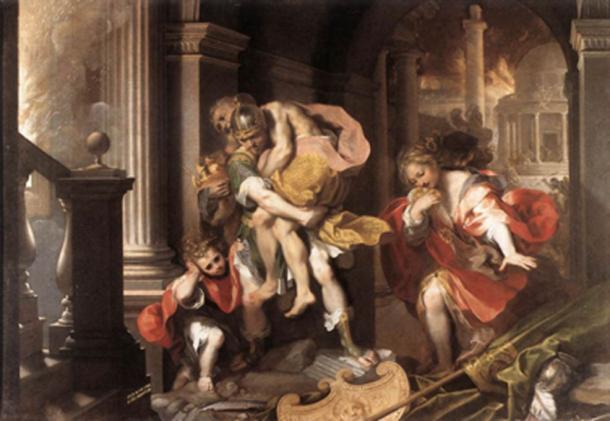
In Virgil’s Aeneid, the epic poem conveys the story of the Trojan hero Aeneas fleeing from Troy. (Blackcat / Public Domain )
Belus had planned to divide the kingdom between his two children after he died. Upon the old king’s death, however, Pygmalion seized power for himself and killed Sychaeus for his wealth. Pygmalion regarded his sister as a threat to his power as well and prepared to murder her. Fortunately, Sychaeus’ ghost appeared to Dido in a dream and told her the truth about his death. He also revealed to her the location where he had hidden his wealth and warned her to flee the city.
Once Dido had retrieved her husband’s wealth, she fled from Tyre with a group of loyal followers. Dido sailed across the Mediterranean and eventually arrived on the shores of North Africa , where she founded the city of Carthage.
As the founders of Carthage were from Tyre, they brought along with them the religion and belief system of their mother city. Therefore, similarities can be found between religious beliefs of the Carthaginians and Tyrians. This is most visible in the gods worshipped by these two peoples.
The Carthaginians, Tyrians, and Phoenicians as a whole, were polytheists and believed in a pantheon of gods. Many of the gods worshipped in Carthage were derived from the Tyrian pantheon, though they were localized and given local names. The two most important gods worshipped in Carthage were Baal Hammon and Tanit, who together formed the supreme divine couple of the Punic pantheon. The Tyrian of these two gods have been identified as Baal and Astarte (or one of her attendants). 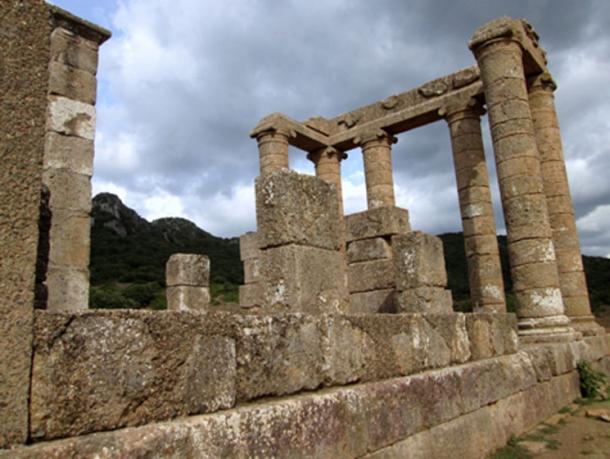
Temple in Carthage used to worship the gods of the Punic pantheon. ( Stemoir / Adobe Stock)
The name Baal Hammon has been interpreted by scholars to mean ‘Lord of the Brazier’ or ‘Lord of the Altar of Incense’. He was considered to be a god of fertility and worshipped by the Carthaginians as the king of the gods. Baal Hammon was but one version of the deity Baal. This god is found in the pantheons of many ancient Middle Eastern communities and was worshipped especially by the Canaanites, which the Phoenicians were a part of.
Like Baal Hammon, the Baal of the Middle East was believed to be a fertility god, though he was not considered to be the leader of the gods in the Canaanite pantheon. Instead, that title was held by El, whose consort was Asherah. As Baal Hammon was also the king of the gods, some scholars have also speculated that he was the Punic equivalent of El. 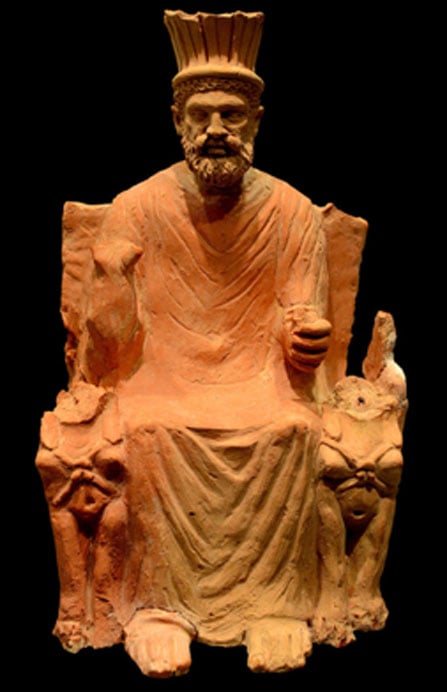
Baal Hammon, king of the Punic pantheon, on his throne with a crown and flanked by sphinxes. (Dyolf77 / CC BY-SA 4.0 )
The role played by Baal in ensuring the fertility of the land is reflected in one of his titles, ‘Lord of Rain and Dew’, which were the two forms of moisture that the Canaanite farmers depended on. Rain was probably the more vital of the two, as Baal was also regarded to be a storm god. This is visible in the epithet given to him in Ugaritic and Hebrew, ‘He who Rides on the Clouds’, as well as the name given to him by the Phoenicians, ‘Baal Shamin’, meaning ‘Lord of the Heavens’.
Other gods who were known as Baal include Baal Qarnem, Baal Iddir, and Baal Oz. It is unclear, however, whether these were different forms of Baal or distinct deities in their own right.
The consort of Baal Hammon was Tanit, who is usually said to have been the equivalent of the Canaanite goddess Astarte. Tanit was not originally part of the Punic pantheon and her worship only began after the 5th century BC. Nevertheless, she soon superseded Baal Hammon in importance. This is seen, for instance, in Carthaginian monuments where her name is often placed before that of Baal Hammon.
Tanit is considered to be the consort of Baal Hammon, one of her titles being ‘face of Baal’. Although Tanit was worshipped as a celestial goddess, the Carthaginians also believed that she was a mother goddess who governed fertility, as her representations are often accompanied by fertility symbols.
The most unique aspect of Tanit is that she is the only Punic deity known to be represented by a symbol. Tanit’s symbol is easily recognized and consists of a triangle / trapezium with a horizontal line and circle above it. Scholars are of the opinion that the symbol represents a stylized female figure with outstretched arms. 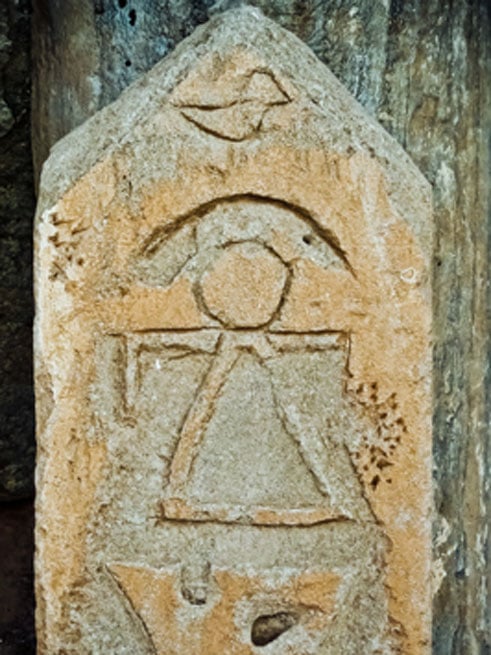
Symbol of Tanit, the consort to the king of the Punic pantheon. (mrholle / CC BY-SA 2.0 )
Another important deity in the Punic pantheon was Melqart (known also as Tyrian Baal), the chief deity and protector of Tyre. Some scholars speculate that for the Carthaginians, Melqart and Baal Hammon were in fact one and the same. The cult of Melqart helped to maintain the link between Carthage and its mother city.
For the first few centuries of its existence, Carthage was obliged to send one-tenth of its annual profit to the Temple of Melqart in Tyre as tribute. Additionally, the Carthaginians and Tyrians would come together in Tyre each year to celebrate the resurrection of Melqart in a festival referred to by Greek authors as ‘Egeris’.
Other important Phoenician deities brought from Tyre to Carthage included Eshmun, Reshef, and Rasap. Eshmun has been recognized as the equivalent of Adonis and the Greeks have identified him as being similar to their own god of healing, Asclepius. In Sidon, the mother city of Tyre, Eshmun was part of the divine trio, along with Baal and Astarte. Reshef was worshipped as the god of fire and lightning (equated with Apollo by the Greeks), while Rasap was a god of war. Like Baal Hammon and Tanit, these gods were also localized by the Carthaginians.
In addition, the Carthaginians included in their pantheon deities from other civilizations they came into contact with, such as the Greeks, Egyptians, and Etruscans. An example of this adoption of foreign gods may be seen on a Punic stele dating to the late 2nd century BC.
On this artifact are three symbols, one of which is a caduceus. In the Greek world, this object was an attribute of the god Hermes. Therefore, it is possible that Greek god was part of the Punic pantheon. 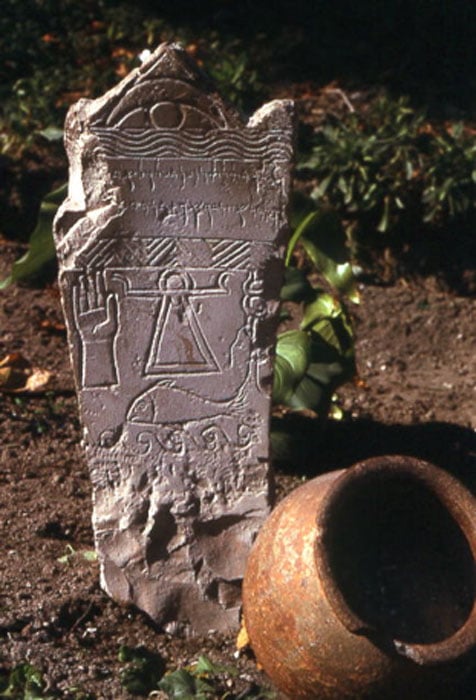
Punic stele in Carthage. (Michel-georges Bernard / CC BY-SA 3.0 )
In Tyre, the hierarchy of the religious cults was headed by its monarch. Beneath the king were the priests, who were grouped into colleges and led by a chief priest. The priests, and in particular the chief priests, wielded great power and possessed immense wealth in Tyrian society.
In one version of the myth of Dido, her husband’s name was Acerbas, who was her uncle and also a priest of Melqart. It was due to his status as a priest that Acerbas was able to grow wealthy.
The Tyrian settlers of Carthage maintained the priesthoods of their mother city. The temple priests and their acolytes performed different functions and charged a fee for their services. During the first few centuries of Carthage’s founding its priests conducted ritual celebrations derived from Phoenician traditions, which demonstrates its strong ties with the mother city.
The most intriguing and controversial aspect of Punic religious practice is the alleged child sacrifice that was practiced by the Carthaginians. In Biblical sources, the Canaanite deity associated with child sacrifice was Moloch. The name of this god is a combination of the consonants of melech (Hebrew for ‘king’) and the vowels of boshet (Hebrew for ‘shame’). Some scholars, however, have suggested that Moloch was not the name of a god but was a type of sacrifice instead. This theory, however, is generally rejected and scholars normally regard Moloch as a deity.
Nevertheless, there is disagreement as to the kind of god Moloch was. While some scholars are of the opinion that Moloch was a god in his own right, others have proposed that this was a title given to one of the foreign gods that the Israelites encountered in the land of Canaan. For instance, one suggestion is that Moloch was just another name for Baal. 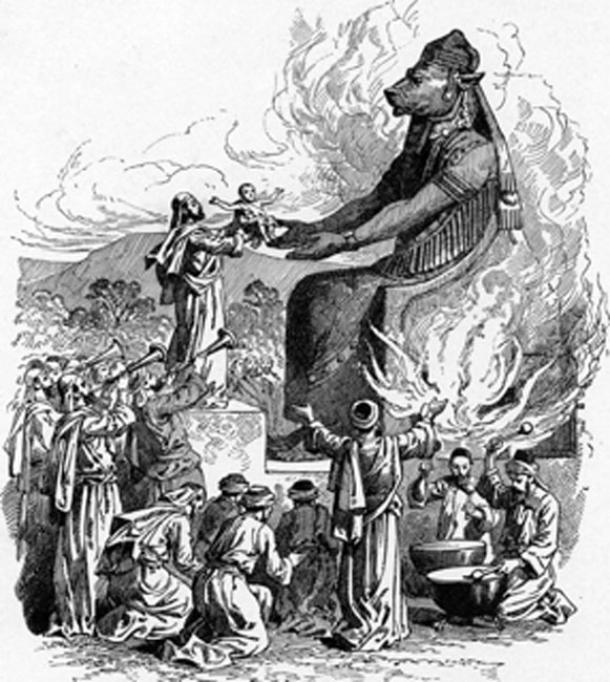
Moloch was the Canaanite deity, of the Punic pantheon, associated with child sacrifice. (Dauster / Public Domain )
In any case, child sacrifice was reputed to have been practiced by the Phoenicians and may have been inherited by the Carthaginians. The matter, however, is not so straightforward and there are disagreements as to whether this gruesome type of sacrifice was indeed performed by the Carthaginians. Among the ancient authors, for instance, there are those who mention this practice, as well as those who do not.
The Roman writer Plutarch and the Greek historian Diodorus Siculus belong to the former, while Livy and Polybius belong to the latter. Additionally, the early Christian writers Tertullian and Orosius also make mention of Carthaginian child sacrifices in their writings. One argument against those ancient writers who wrote about the child sacrifices is that they were the enemies of Carthage and therefore made such claims as propaganda to present the Carthaginians in a negative light.
The dispute has not been resolved by archaeology. Instead, the archaeological evidence has been used by both sides to support their own arguments. In areas once ruled by the Carthaginians, archaeologists have discovered cemeteries used specifically for the burial of infants and babies. The term Tophet, which may be translated to mean ‘place of burning’, is used to describe such cemeteries, and is derived from the Bible.
Some scholars have argued that those buried in such cemeteries were not victims of sacrifice but had died of natural causes. This is seen, for instance, in a study of dental remains from 540 individuals, published in 2010. The authors of the study, Jeffrey Schwartz, Frank Houghton, Roberto Macchiarelli, and Luca Bondioli argue that the majority of the those buried in the cemetery were either stillborn babies or fetuses.
This has been used to refute the idea that the Carthaginians ritually slaughtered their children, as the individuals buried in the cemetery could not have been considered to be live sacrifices. One critique of this study comes from Patricia Smith, an anthropologist at Hebrew University in Jerusalem, who argues that that the authors have miscalculated the age of the infants. This means that those buried in the cemetery were not stillborn individuals or fetuses but babies who were about a month old. This in turn brings back the possibility of child sacrificed being practiced in Carthage. 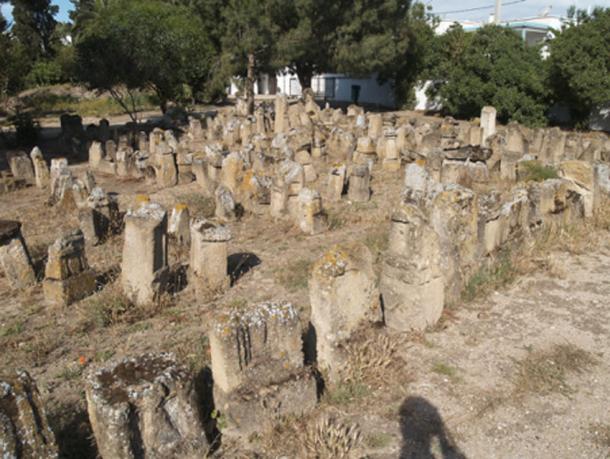
Punic cemetery at Carthage where evidence of infant burial is found. (Institute for the Study of the Ancient World / CC BY-SA 2.0 )
The idea of child sacrifice is repugnant today, and it is possible that we are trying to do away with this inconvenient truth by discrediting the evidence or by imposing our modern sensibilities onto the ancient Carthaginians. Instead of dismissing outright the idea that child sacrifice was practiced in Carthage, Josephine Quinn of Oxford University’s Faculty of Classics has proposed that we ought to try to understand this phenomenon.
For instance, she suggests that Carthaginian parents may have believed that by sacrificing their children they would bring greater good to their family and community. She also notes that this practice may provide an alternative explanation for the founding of Carthage, i.e. that its founders were forced to leave Phoenicia since others frowned upon their unusual religious practice.
Top image: Queen Dido, founder of Carthage and the Punic pantheon. Source: Eloquence / Public Domain .
By Wu Mingren
Cartwright, M. 2016. Carthaginian Religion . [Online] Available at: https://www.ancient.eu/Carthaginian_Religion/
Church, A. 1886. Story of Carthage, Part III, Chapter II: The Constitution and Religion of Carthage . [Online] Available at: https://www.heritage-history.com/index.php?c=read&author=church&book=carthage&story=religion
Clifford, R. 1990. Phoenician Religion . Bulletin of the American Schools of Oriental Research, Volume 279, pp. 55-64.
DHWTY. 2019. Dido of Carthage, Mediterranean Princess Turned African Queen . [Online] Available at: https://www.ancient-origins.net/history-famous-people/dido-carthage-0011628
Ghose, T. 2012. Ancient Baby Graveyard Not for Child Sacrifice, Scientists Say . [Online]
Available at: https://www.livescience.com/23298-carthage-graveyard-not-child-sacrifice.html
New World Encyclopedia. 2017. Carthage. [Online] Available at: https://www.newworldencyclopedia.org/entry/Carthage
New World Encyclopedia. 2018. Moloch. [Online] Available at: https://www.newworldencyclopedia.org/entry/Moloch
New World Encyclopedia. 2019. Canaanite Religion . [Online] Available at: https://www.newworldencyclopedia.org/entry/Canaanite_Religion
Schwartz, J., Houghton, F., Roberto Macchiarelli, & Bondioli, L. 2010. Skeletal Remains from Punic Carthage Do Not Support Systematic Sacrifice of Infants . [Online] Available at: https://journals.plos.org/plosone/article?id=10.1371/journal.pone.0009177
The Editors of Encyclopaedia Britannica. 2013. Melqart. [Online] Available at: https://www.britannica.com/topic/Melqart
The Editors of Encyclopaedia Britannica. 2014. Tanit. [Online] Available at: https://www.britannica.com/topic/Tanit
The Editors of Encyclopaedia Britannica. 2016. Moloch. [Online] Available at: https://www.britannica.com/topic/Moloch-ancient-god
The Editors of Encyclopaedia Britannica. 2018. Baal. [Online] Available at: https://www.britannica.com/topic/Baal-ancient-deity
The Louvre. 2019. Punic stele with triangular pediment . [Online] Available at: https://www.louvre.fr/en/oeuvre-notices/punic-stele-triangular-pediment
University of Oxford. 2014. Ancient Carthaginians really did sacrifice their children . [Online] Available at: http://www.ox.ac.uk/news/2014-01-23-ancient-carthaginians-really-did-sacrifice-their-children
www.pheniciens.com. 2019. The Religion . [Online] Available at: http://www.pheniciens.com/articles/religion.php?lang=en
Wu Mingren (‘Dhwty’) has a Bachelor of Arts in Ancient History and Archaeology. Although his primary interest is in the ancient civilizations of the Near East, he is also interested in other geographical regions, as well as other time periods…. Read More

Ancient Origins has been quoted by:
At Ancient Origins, we believe that one of the most important fields of knowledge we can pursue as human beings is our beginnings. And while some people may seem content with the story as it stands, our view is that there exist countless mysteries, scientific anomalies and surprising artifacts that have yet to be discovered and explained.
The goal of Ancient Origins is to highlight recent archaeological discoveries, peer-reviewed academic research and evidence, as well as offering alternative viewpoints and explanations of science, archaeology, mythology, religion and history around the globe.
We’re the only Pop Archaeology site combining scientific research with out-of-the-box perspectives.
By bringing together top experts and authors, this archaeology website explores lost civilizations, examines sacred writings, tours ancient places, investigates ancient discoveries and questions mysterious happenings. Our open community is dedicated to digging into the origins of our species on planet earth, and question wherever the discoveries might take us. We seek to retell the story of our beginnings.
Ancient Origins © 2013 – 2022
Disclaimer – Terms of Publication – Privacy Policy & Cookies – Advertising Policy – Submissions – We Give Back – Contact us
The Phoenicians: Famed Traders Of The Ancient World – BBC History Magazine
Internationally respected merchants and traders, these ancient peoples left behind one very significant, long-lasting legacy
The Phoenicians were an ancient people who lived in what is now Lebanon (and some surrounding areas). They flourished from c1500 to c300 BC and were famed traders.
Ancient writers believed the Phoenicians had arrived from the Persian Gulf or the Indian Ocean, but modern evidence suggests the society developed c3000 BC out of the Canaanite people in the same region. The first Phoenician city, Byblos, dates back to around this time, but it would be more than 1,500 years before the other great Phoenician cities emerged.
Neither, in the way that we would understand it today. The Phoenicians were more like a confederation of independent city states, the best known of which were Byblos, Tyre, Sidon and Arwad.
The Phoenicians developed trading networks across the Mediterranean and, to support these, they established small colonies along the coasts of Europe and North Africa – reaching as far west as modern-day Spain. One Phoenician colony, Carthage (in what is now Tunisia), ended up becoming a major power in its own right.
It was coined by the ancient Greeks. A popular theory is that the name derived from the Greek word for the colour of an expensive purple dye that the Phoenicians extracted from sea snails. The Phoenicians would not have referred to themselves by this name, and the term they used is not known.
It was probably because of the geography of their lands. The region was not suited to farming, but had a long Mediterranean coast as well as cedar forests – a wood prized across the ancient world. So trading made good economic sense and, as the centuries progressed, they became highly skilled at it. They were renowned for the speed of their ships, their genius for navigation and their craftsmanship. The Phoenicians traded all manner of things including linen, wine, spices, slaves and, of course, cedar wood.
Much of what we now know about the Phoenicians is based on the reports of other peoples who encountered them, including the Egyptians, the Greeks and the Israelites. As well as trading with these civilisations, the Phoenicians often lived under the domination of the more powerful ones, beginning with ancient Egypt. Some of these overlords allowed the Phoenicians to operate relatively freely, valuing their trading and communication networks.
One ruler who went to war against the Phoenicians, however, was the Macedonian king Alexander the Great. In 332 BC, he captured the Phoenician city of Tyre and put thousands of its inhabitants to the sword, selling tens of thousands more into slavery. Nearly 200 years later, Rome crushed the great Phoenician outpost of Carthage and by 64 BC the Phoenician city states had all been incorporated into the Roman Empire.
How Hannibal beat the Alps but couldn’t beat Rome
Robin Lane Fox explains how the classical general, famed for his crossing of the Alps, was defeated because he couldn’t fulfil his promise of liberation from Rome…
It was undoubtedly their alphabet. Created c1000 BC, the Phoenician writing system of 22 letters was in itself not very revolutionary. In fact, it was really only a modification of similar alphabets that already existed in the region.
Yet, because they were traders, the Phoenicians spread their alphabet all over the Mediterranean region and introduced it to people of many different civilisations. It soon became a valuable tool for international commerce and was almost certainly the source of the Greek alphabet, which later inspired the one that most Western languages – including English – use today.
This content first appeared in the May 2015 issue of BBC History Revealed
Rob Attar is the editor of BBC History Magazine
Save up to 40% when you subscribe today and receive a book for your choice worth up to £30 PLUS free access to HistoryExtra.com
Sign up to receive our newsletter!
By entering your details, you are agreeing to our terms and conditions and privacy policy. You can unsubscribe at any time.
Subscribe from £19.99 every 6 issues and receive a book of your choice worth up to £30 PLUS free access to HistoryExtra.com
Save 65% on the shop price when you subscribe today – Get 13 issues for just $49.99
Listen to the latest episodes now
Inscribed Curse on the Sarcophagus of King Ahiram Displays Earliest Use of Phoenician Alphabet – Ancient Origins
The Sarcophagus of King Ahiram (spelled also as Ahirom) is an incredible monument that was unearthed in Lebanon. As its name suggests, the sarcophagus belonged to a king by the name of Ahiram, who was a ruler of the ancient Phoenician city of Byblos (as the Greeks called it, and is now known as Jubayl / Jbeil). This sarcophagus is notable for its bas reliefs, and more importantly, its inscription. The engraved curse is said to be the earliest known example of the fully developed form of the Phoenician alphabet, hence its great significance. 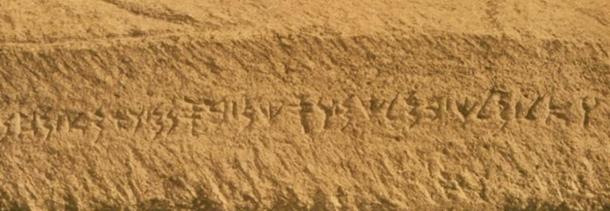
Part of the inscription on the sarcophagus of King Ahiram ( 3000 slides project )
The Sarcophagus of King Ahiram was discovered in 1923 during an excavation in Byblos. During that excavation, which was led by the French archaeologist Pierre Montet, nine tombs belonging to the Phoenician kings of Byblos were discovered. These tombs were exposed as a result of heavy rains that caused the collapse of parts of a hill. The tombs were cut directly out of the rock, and it was in tomb V that Ahiram’s sarcophagus, which is made of limestone, was found.
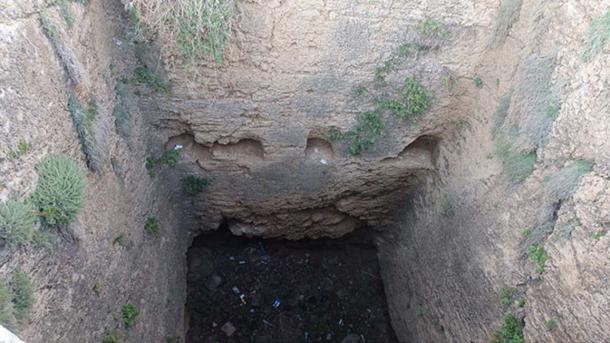
Tomb of Phoenician king Ahiram (CC BY-SA 3.0 )
Initially, the sarcophagus was thought to have belonged to the 13 th or 12 th century BC, due to other artifacts in the tomb that date to this period. This dating, however, was later challenged by scholars who examined the sarcophagus’ inscription. Today, King Ahiram is commonly believed to have ruled over Byblos around 1000 BC. It has been pointed out that King Ahiram is not attested in the known literary corpus of the ancient Near East. His sarcophagus, however, is evidence of this ancient king’s existence. By 3000 BC, Byblos had grown from a little village into a wealthy city thanks to trade. Around the time of Ahiram’s rule, however, Byblos was beginning to decline in importance, losing out to its nearby sister city, Tyre. 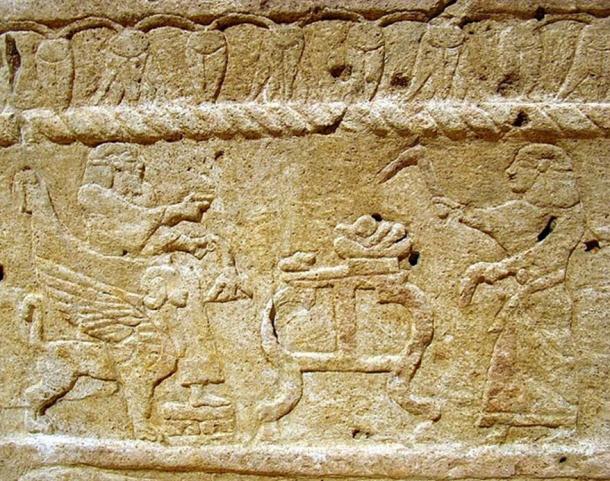
Relief on Sarcophagus of Ahiram, King of Byblos ( Public Domain )
The Sarcophagus of King Ahiram has been regarded as a major example of a piece of early Phoenician art. It is known that Byblos had strong trade relations with Egypt. Some scholars even go so far as to consider Byblos as a ‘colony’ of that ancient superpower. Regardless, it is evident that Egyptian culture and religion had a great influence on the people of Byblos, and this can be seen, for example, in their art. King Ahiram’s sarcophagus, however, is interesting, as it displays a reduced dependence on this Egyptian influence. For example, the dress, beard and coiffure of the male figures on the sarcophagus suggest an influence coming from Northern Syrian, rather than from Egypt.
The other, arguably more important, aspect of the sarcophagus is the inscription that was found on it. This inscription was carved above a relief on the upper rim and lid of the sarcophagus. The inscription has been translated as follows:
“A coffin made it [It]tobaal, son of Ahirom, king of Byblos, for Ahirom, his father, lo, thus he put him in seclusion. Now, if a king among kings and a governor among governors and a commander of an army should come up against Byblos; and when he then uncovers this coffin – (then:) may strip off the sceptre of his judiciary, may be overturned the throne of his kingdom, and peace and quiet may flee from Byblos. And as for him, one should cancel his registration concerning the libation tube of the memorial sacrifice.” 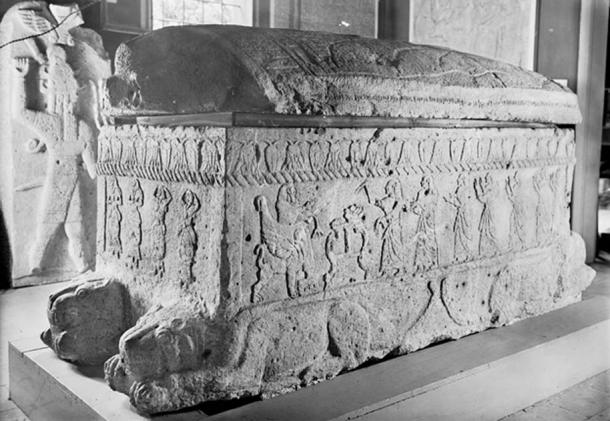
Sarcophagus of Ahiram, King of Biblos. ( Public Domain )
From the inscription, it is known that the sarcophagus was made for Ahiram by his son, Ittobaal. The rest of the inscription is essentially a curse intended to protect the sarcophagus and its contents from would-be desecrators. This, however, did not deter tomb robbers from looting the tomb in antiquity. Nevertheless, the sarcophagus was left in the tomb for archaeologists to discover in the future. It has also been noted that 19 of the 22 letters that make up the Phoenician alphabet are present in this inscription, and is at present the earliest known example of the fully developed form of the Phoenician alphabet. Today, the Sarcophagus of King Ahiram is kept in the National Museum of Beirut in Lebanon.
Top image: Sarcophagus of Ahiram, King of Byblos (Phoenicia). Beirut National Museum. Photo source: Public Domain
By Wu Mingren
Beirut National Museum, 2016. The Sarcophagus of King Ahiram. [Online]
Available at: http://en.beirutnationalmuseum.org/?page_id=29
Bloch-Smith, E., 2016. Sarcophagus of Ahirom, 10th century BCE. [Online]
Available at: http://cojs.org/sarcophagus_of_ahirom-_10th_century_bce/
Cline, A., 2016. Funeral Rites & Burial Among the Ancient Phoenicians. [Online]
Available at: http://atheism.about.com/od/ancientmythologyreligion/ig/Lebanon-Phoenician-Photos/Sarcophagus-Ahiram-Byblos.htm
Kelpla, 2013. The Sarcophagus of King Ahiram of Byblos. [Online]
Available at: https://thedailybeagle.net/2013/02/22/the-sarcophagus-of-king-ahiram-of-byblos/
LebanonUntravelled, 2016. King Ahiram Sarcophagus and the Alphabet. [Online]
Available at: http://lebanonuntravelled.com/king-ahiram-sarcophagus-and-the-alphabet/
Markoe, G. E., 1990. The Emergence of Phoenician Art. Bulletin of the American Schools of Oriental Research, Volume 279, pp. 13-26.
www.lrc.lsa.umich.edu, 2016. Sarcophagus Of Ahiram, King Of Byblos. [Online]
Available at: https://www.lrc.lsa.umich.edu/eliav/shalosh-eleph/items/show/5050
Wu Mingren (‘Dhwty’) has a Bachelor of Arts in Ancient History and Archaeology. Although his primary interest is in the ancient civilizations of the Near East, he is also interested in other geographical regions, as well as other time periods…. Read More
I’ll let you in on a secret: the reason I, a Greek, can read these letters is because this is not some imaginary “Semitic” peoples’ alphabet (very inaccurate terminology, btw, it’s not an alphabet), is because they are Greek letters! But written from right to left and the vowels are missing.
The article states that only 19 of the 22 letters are present, was the H one of them. Then it could definitely been Hiram. If Phoenician, like other ancient languages had no vowels, that would explain the Ahiram Ahirom spellings and the lack of the capital A
well, is he still in there ? or was body taken long ago ?? No pics if hes there ?
I hate less pictures. Those who have joy of going there, should provide pics to share with the world.
"It has been pointed out that King Ahiram is not attested in the known literary corpus of the ancient Near East."
I am at a loss: Surely that would be Hiram, who I would think is well attested?
Ancient Origins has been quoted by:
At Ancient Origins, we believe that one of the most important fields of knowledge we can pursue as human beings is our beginnings. And while some people may seem content with the story as it stands, our view is that there exist countless mysteries, scientific anomalies and surprising artifacts that have yet to be discovered and explained.
The goal of Ancient Origins is to highlight recent archaeological discoveries, peer-reviewed academic research and evidence, as well as offering alternative viewpoints and explanations of science, archaeology, mythology, religion and history around the globe.
We’re the only Pop Archaeology site combining scientific research with out-of-the-box perspectives.
By bringing together top experts and authors, this archaeology website explores lost civilizations, examines sacred writings, tours ancient places, investigates ancient discoveries and questions mysterious happenings. Our open community is dedicated to digging into the origins of our species on planet earth, and question wherever the discoveries might take us. We seek to retell the story of our beginnings.
Ancient Origins © 2013 – 2022
Disclaimer – Terms of Publication – Privacy Policy & Cookies – Advertising Policy – Submissions – We Give Back – Contact us

Menorca’s ‘houses of the dead’ reveal these ancient secrets – National Geographic UK
From atop Menorca’s megalithic stone towers, watchers would have witnessed the tides of history roll across the island with the successive waves of the ancient Mediterranean superpowers—the Phoenicians, Greeks, and Romans.
But long before those heavyweights stepped ashore, the island’s humble pioneers carved out a life on the windswept, largely treeless landscape. Those towers, called talayots, were built from the raw material those first inhabitants and their descendants found in abundance—blocks of limestone. By simply making do with what they had, the Menorcans created a legacy set in stone.
To most, Spain’s Balearic Islands may be better known for the jet-set beach destinations of Ibiza and Mallorca. But tranquil Menorca, the easternmost link in the chain, combines that natural beauty with a unique treasure trove—the archipelago’s greatest repository of ancient architecture. Within these towers and other “cyclopean” structures—made from unhewn, mortarless stones—lies an island history knit together over a millennium, leaving its mark on the Menorcan landscape and identity.
The earliest signs of this distinctive architecture are tied to burial mounds that probably date to 2000 B.C. Those simple megalithic tombs, or dolmens, eventually gave way to the first cyclopean constructions—dwellings shaped like upside-down ship hulls called navetas—around 1600 B.C. Four hundred years later, talayots, derived from the Arabic talaya (“watchtower”), sprouted up and lent their name to the Talayotic island culture that created them.
The widespread rise of these unique truncated cones coincided with the growth of local communities. Starting from a talayot centre, a settlement gradually fanned out, and over time new building designs appeared: taula shrines that to some evoke the Stonehenge pillars, circular dwellings, and extensive walls.
Today these remnants of the Talayotic Menorcan culture are a candidate for UNESCO’s World Heritage List, a designation of global cultural value. (The decision had been scheduled for a June meeting of the World Heritage Committee in Russia but has been postponed due to the Russian invasion of Ukraine.)
Experts divide this fruitful culture that endured for nearly 2,000 years into four periods, its long run ending in 123 B.C., the year a Roman fleet conquered the island along with Mallorca and began to colonise them. It changed the course of Menorca’s history, but its architecture remained, and in some cases was used even up until the Islamic period, which began in the 10th century.
The buildings stand out not only for their diversity but also because the island has one of the world’s highest concentrations of archaeological sites, ranging from the foundation blocks of small dwellings to well-preserved village centres. In an area of just 270 square miles, Menorca has a total of 1,574 inventoried spots.
The island “is home to 9 percent of Spain’s Assets of Cultural Interest, with just 0.13 percent of its land,” according to Margarita Orfila, an archaeology professor who co-authored the World Heritage application. Inclusion in the list would elevate the island’s international profile, enhance conservation measures, promote new research, and foster tourism beyond the busy summer season.
With their sheer numbers, the icons are also omnipresent. “In the rest of the world,” Orfila points out, “most comparable archaeological landscapes are in national parks or reserves, where there is little human activity, and they aren’t prominent.”
But throughout Menorca, and particularly in the nine proposed areas for designation, there is “an exceptional living archaeological landscape, which is fully integrated with daily life in 21st-century Menorca.” The colossal stones stand among fields of crops and grazing cows and sheep, seemingly murmuring ancient tales about the island’s first inhabitants.
But who were they? “They came from the northeast of the Iberian Peninsula or the area [in today’s France] around the Gulf of Lion,” suggests Joaquim Pons, an archaeology specialist at the Island Council’s Department of Culture. The conclusion is based on two factors: prevailing winds and currents would have carried boats to the islands, and Menorca’s burial sites are oriented toward the sunset—the same as those around the Gulf of Lion, whereas in the rest of the Mediterranean they’d face sunrise.
“They reached the coast of Menorca in the second half of the third millennium B.C. aboard rudimentary boats, along with some domesticated animals and basic utensils,” he adds. “Perhaps they decided to undertake such a risky journey because they were fleeing hostile situations on the mainland.”
The perilous sea voyage took them to a rocky and largely unfertile land with limited resources where a tough life awaited them. According to studies of graves using carbon dating and DNA analysis, half of the children under five years old died of disease, and although adult life expectancy could reach 50 years, it usually did not exceed 25. Those same studies revealed a dietary surprise: despite being surrounded by the sea, they consumed no fish or seafood, instead relying on meat, grains, and legumes.
With settlements clustered inland and the shoreline reserved for burials—which gradually moved closer to the sea and eventually into coastal cliffs—it was as if the sea was sacred, an infinite expanse that merged with the sky in a place akin to the afterlife.
The first settlers buried their dead collectively in hypogea, caves dug into the rocky terrain, or in dolmens, probably following the traditions from their ancestral homeland. The grave goods and the use of collective burials suggest a society that lacked hierarchy.
Soon, though, the islanders would tap into the ubiquitous stone, which ultimately lead to the island’s first cyclopean constructions, some of them unique to Menorca.
The first of these was the naveta dwelling (Catalan for “small ship”), shaped like an inverted boat. It typically measured between 16 to 66 feet long by 10 feet wide, providing shelter for large families. Inside they cooked and warmed themselves around a central fire, sitting on stone benches attached to the walls.
Throughout this period, known as the Naviform (derived from “naveta”), between 1600 and 1200 B.C., the population settled in small villages and focused on agriculture and livestock. These societies also learned to extract copper from their prehistoric mines and, by mixing it with imported tin, they forged a highly versatile material for making tools and utensils: bronze.
Although they continued to use hypogea, they soon began to build monumental naveta tombs, with the Naveta des Tudons being the best known. “The similarities between the naveta houses and the funerary navetas force us to think of a symbolic translation,” Joaquim Pons says. “The ‘houses of the dead’ took on the exterior form of the ‘houses of the living.’”
These naveta tombs were always built far from the village and out of view. “The world of the living was separated from the world of the dead,” Orfila explains. Later on, the dead were buried in caves carved into ravines that crisscross the island, and gradually those were made ever closer to the coast, as if to bring the dead to the sea.
In the late Bronze Age and the early Iron Age, between 1200 and 500 B.C., an increase in population brought about a landscape transformation in the form of the talayots, which required a colossal collective effort to build, a sign of advancing civilisation.
In the centuries that followed, another unique Menorcan feature emerged: the taula (“table” in Catalan) in a horseshoe-style enclosure. Seen as a place of worship, with an apse-like floor plan and cyclopean walls, the taula was at its centre, a T-shaped slab structure four or five metres (13 to 16 feet) high. “The ritual and religious function of these shrines,” says Orfila, “is documented by the presence of fire, the remains of sacrificed animals, and bronze statuettes, as well as the direction they face.”
“It is a rather peculiar fact, echoed in the [southwest] orientation of tombs in the French region of Languedoc, where the island’s first settlers may have come from,” says Antoni Ferrer, an archaeologist at the Menorcan Institute of Studies. All but one of the taulas (of the 31 documented, seven remain standing), on the other hand, face south.
The late British archaeoastronomer Michael Hoskin theorised that the structures were built in places with an uninterrupted view of the southern horizon and might have been oriented to observe the seasonal Centaurus constellation.
In a later period, another design revolution in the island’s prehistoric architecture appeared in the concept of a dwelling with a circular floor plan, organised around a central courtyard, bound by six columns. Built with double-faced walls and a clay and earthen roof, they’re more complex than the naveta houses. Some even had cisterns to collect water.
At the same time, cyclopean walls began to proliferate around the villages. The Mediterranean was then in the process of being colonised by the Phoenicians, Greeks, Carthaginians, and Romans. For the Menorcan society that had lived in peaceful isolation for centuries, the sea represented a way to achieve wealth through trade, but it also brought the dangers of pirates and the fleets of rival powers.
From the fifth century B.C. onward, many young men from Menorca and Mallorca, skilled with slings, were recruited as mercenaries by the Punic armies, until they were absorbed by Rome after the fall of Carthage: “Both islands,” says Ofila, “came to be called the Balearic Islands, a name derived from the Greek baleo, which means to throw.”
Historical sources refer to the Balearic slingers, including Strabo in Geographica: “[T]heir training in the use of slings used to be such, from childhood up, that they would not so much as give bread to their children unless they first hit it with the sling. This is why [Roman commander] Metellus, when he was approaching the islands from the sea, stretched hides above the decks as a protection against the slings.”
Talayotic culture came to an end in the final years of the second century B.C., giving way to a long period of Romanisation that would end with the invasion by the Vandals in A.D. 455 The Byzantine Empire took over the island in 534, and in 903 it was the turn of the Moors, who remained for 400 years until the arrival of King Alfonso III of Aragon.
From the 14th century onward, the descendants of the Talayotic people emulated their ancestors by building mortarless walls as boundaries for farms. Today a veritable “great wall” of Menorca remains—about 11,000 kilometres (nearly 7,000 miles) of these beautiful walls snake through the island, the same distance that separates its town of Ciutadella from Santiago de Chile in South America. Through its most essential material, the island connects its present to its prehistoric past, the eternal bond between the Menorcan people and their land.
This story was adapted from National Geographic’s Spain edition.
2600-Year-Old Phoenician Winery Discovered in Lebanon – VinePair
Booze News
updated: September 16, 2020
updated: September 16, 2020
Wine drinking culture dates back thousands of years. Further evidence of that was recently unearthed when archeologists in Lebanon excavated a wine press believed to be used as early as 7th century B.C., as reported Monday by National Geographic.
The remains of the 2,600-year-old wine press were discovered during an archaeological dig at Tell el-Burak, a Lebanese city that lies close to the Mediterranean sea, in what would have been ancient Phoenician homelands. The study was first published by the journal Antiquity.
The press comprises a large basin where grapes are believed to have been crushed by foot. The resulting liquid then collected in a lowered vat before it was likely stored in jars known as “amphorae” for fermenting and aging.
According to archaeologist Hélène Sader, co-director of the Tell el-Burak Archaeological Project, “Wine was an important Phoenician trading item.” But up to this point, little evidence of ancient winemaking had been discovered in Lebanon.
The Phoenicians are credited with spreading wine and olive oil throughout the Mediterranean, University of Toronto archaeologist Stephen Batiuk told National Geographic. The civilization introduced wineries and vineyards to colonies throughout Spain, France, Sicily, and North Africa.
“The Phoenicians perhaps introduced a drinking culture,” Batiuk says, along with “[new] drinking vessels, and a different way of relating to wine.”
AAA Lecture: Seafaring in the ancient Mediterranean – Portugal Resident
On Tuesday, June 7, the Algarve Archaeological Association (AAA) will be presenting two lectures, in English, by Graham Cross. The first lecture will be at 2.30pm at the Museu do Traje in São Brás, the second at 6pm at the Convento de São José in Lagoa.
Graham Cross, a member of the AAA, will be presenting a brief history of seafaring in the ancient Mediterranean and will cover a number of topics. These include the expansion and exploration of the Phoenicians, developments in Greece and the role of triremes in the repulse of Persian invasions. He will also talk about the Athenian maritime empire, the puzzle of the precise construction of the trireme and the later developments of multi-oared naval vessels in the eastern Mediterranean. Graham will explore the maritime elements of the struggle between Rome and Carthage, trade under the Roman Empire and the role of the navy in protecting the empire and expanding it in Northern Europe.
Graham Cross works as a technical and legal translator. He has had a lifelong amateur interest in history and archaeology, having assisted in the excavation of the Roman legionary fortress at Chester, UK in the 1960s and being a member of the Chester Archaeological Society for over 40 years. Graham is also a qualified yachtmaster with an interest in and practical experience of sailing traditional working sailing craft.
Non-members are welcome to attend AAA lectures for a €5 admission fee, with all money raised by the AAA being used for archaeological grants and speakers.
For more information, contact algarvearchass@gmail.com, visit arquealgarve.weebly.com or Facebook ‘Algarve Archaeological Association’. Please check the website or Facebook page for any last-minute changes.
By JANE ROBERTSON
If you are considering moving to the Algarve permanently at some time in the future, living here part time or maybe looking at setting up a business in the Algarve, our seminars offer a unique opportunity to have all your questions answered in one place, at one time.
Next seminar: 22nd September 2022, Conrad Algarve Hotel
Save your Free Seats
September 29, 2022 Edition
Did the Phoenicians Reach the Americas Before Columbus Did? – Hydro International
Expedition leader Philip Beale, Yuri Sanada, a film producer, and ten crew members have embarked on an expedition to prove the possibility of the Phoenicians being the first ancient sailors to have reached the Americas over 2,000 years before Christopher Columbus. Apart from being passionate about the Phoenician history and culture, the crew is collecting sea samples to record the extent of marine litter pollution across the Mediterranean and Atlantic oceans during the Phoenicians Before Columbus Expedition.
Samples of Marine Debris
Beale hopes to use the voyage to increase the visibility of the United Nations Environment Programme’s (UNEP) Clean Seas campaign and as a call to action to fight marine litter. The expedition seeks to collect and analyse samples of marine debris across the Mediterranean Sea and the Atlantic Ocean and make the data openly available. The data will contribute to existing data on surface concentrations of marine litter pollution.
Battle Against Motion Sickness
The treacherous winds of the high seas pose another threat to the ship’s voyage. The crew, on board the 20-metre Phoenician vessel, made up of people of different nationalities, battle daily against motion sickness and the difficulty of being away from family over a long period of time. Determined to make it to the Americas and to document marine litter, the crew is committed to forging ahead. For Beale, the Phoenicians Before Columbus Expedition captain, embarking on the journey means validating the theory and providing data on marine litter.
Sign up for our weekly update on developments, trends and technological advancement in the hydrographic industry.
Download this article as a print friendly PDF and receive our weekly overview of the most important geomatics news and insightful articles and case studies.
Already subscribed or no desire to subscribe to our newsletter? Skip this step and head to the download directly. By submitting this form, you agree to our Terms of Service and Privacy Policy.
Ofcourse we encourage you to share this article with your peers if you enjoyed reading it. Copy the URL below or share it on your social media of choice.
Hydro International started out as a print magazine in 1996 and soon developed into the multimedia platform it is today, featuring a successful website and respected weekly newsletter. Hydro International is published six times a year. The magazine is international in scope and focuses on bringing to its readership topical overviews and the latest news and developments in the technology and management of hydrographic and oceanographic activities.
© 2022 Geomares. Copyright reserved.
This site uses cookies. By continuing to use this website, you agree to our Cookies Policy. Agree