




Nora is arguably the first town ever built on the island of Sardinia, one of the largest islands in the Mediterranean Sea. Their rich and remarkable history includes occupation by Phoenicians, Carthaginians, Romans, Vandals, and Byzantines. For many years the island was an important and prosperous trading hub. Today the town is an open-air archaeology park.
The first known inhabitants of the island were the Nuragic people , renowned for their megaliths. According to Greek sources, the Phoenicians colonized the area sometime in the 8th century BC and founded the first town, then named Norax. Many suppose that the Phoenicians came from the Spanish colonies and used the town to control the trade in the region. The Phoenicians had a good relationship with the inhabitants of the mountainous interior.
Sometime after the Fall of Tyre in the mid-6th century BC, the Carthaginians became the dominant power among the Phoenician settlement and took over Nora, making it a part of their empire. From Nora, they expanded their control of Sardinia into the interior, under the generals Asdrubale and Amilcare. By 509 BC they dominated the island. Based on the tombs excavated in its vicinity, Nora prospered because of its port and the trade in metal ore.
The Romans defeated the Carthaginians in the 3rd century BC and occupied Nora. They built over the Carthaginian town of which very little now remains, although some Carthaginian remains such as the Tophet (religious sanctuary) that was exposed during a storm have come to light. It is believed that the Roman forum was built on top of the Carthaginian plaza. 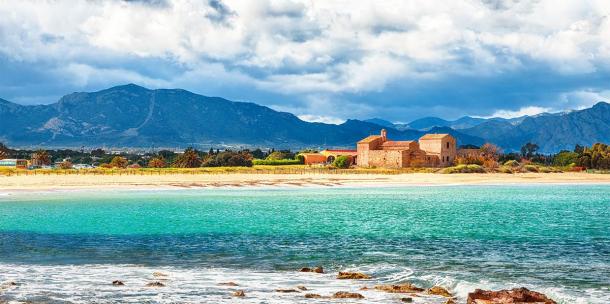
The Nora bay and beach, the medieval Sant’Efisio church near the shore and mountains in the background ( pilat666 / Adobe Stock)
The Romans initially made Nora their provincial capital but later transferred it to Karlais (Caligari). The town, however, remained important and successful until the decline of the Western Roman Empire .
In 455 AD the German tribe, the Vandals, occupied Sardinia and it was then conquered by the Byzantines. By the 6th century AD Nora was no longer a trading center but used as a military settlement and possibly no more than a village. From the 7th century AD, Arab pirate raids forced the inhabitants to move into hilly settlements for protection and the town was abandoned. The site was largely forgotten and was only re-discovered by archaeologists in the 19th century.
The Nora archaeological park is located on the isthmus of Capo Pula. The earliest remains to be seen are the Tophet, where Phoenician-Carthaginian rituals were carried out. Today, only the outline and some stones can be seen. The ruins are located near a Medieval Romanesque Church , dedicated to Saint Efisio, which dates from the 11th century. A religious festival is held in honor of the saint every year and hundreds of people in traditional dress travel from Caligari to Nora. 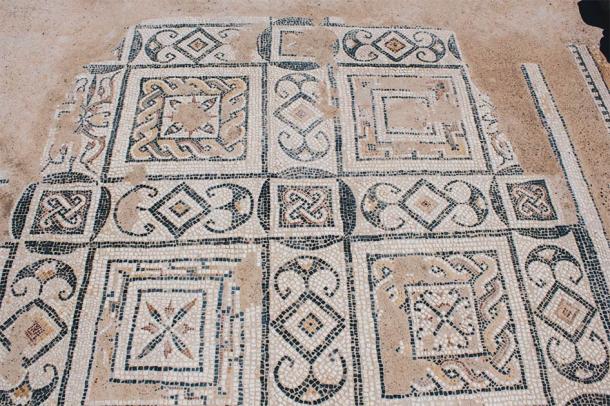
Mosaic – Roman ruins of ancient Nora – Sardinia ( Alessandro / Adobe Stock)
Near the entrance to the park are the remains of a Roman-era thermal bath complex that were popular in the Classical period. Modern cobbled streets lead to the heart of ancient Nora where the remains of a temple and its entrance hall can still be seen. To the north is the site of the ancient necropolis and the aqueduct.
Remains of a well-preserved elite house and its atrium are to be found on the beach. The four-column portico along with several splendid mosaics, including one of a marine centaur, gives us a good impression of what the home of an elite Roman provincial home must have looked like.
The heart of the Nora Archaeological Park is the amphitheater which was originally lined with marble. Spectators once used the terraces to watch the bloody spectacles below but these days it is used for concerts.
To the south of the park is a Greco-Roman religious sanctuary which still has a terrace lined with mosaics. This was once dedicated to the Greek god of healing and medicine, Asclepius.
The archaeological park is located near Pula, near a beautiful beach and lagoon. A fee is charged to visit the park and guided tours are available. Visiting the gift shop or café at Nora Archaeology Park is a great way to relax after soaking in all the fascinating history. The site is overlooked by an ancient tower that dates from the Spanish occupation of Sardinia.
Top image: The watchtower on the Nora peninsula. Famous archaeologic site near Cagliari, Sardinia, Italy
Source: GiorgioMorara / Adobe Stock
By Ed Whelan
Di Maio, R., La Manna, M., Piegari, E., Zara, A., & Bonetto, J. (2018). Reconstruction of a Mediterranean coast archaeological site by integration of geophysical and archaeological data: The eastern district of the ancient city of Nora (Sardinia, Italy). Journal of Archaeological Science: Reports, 20, 230-238
Available at: https://www.sciencedirect.com/science/article/abs/pii/S2352409X18301226
Pilkington, N. (2012). A note on Nora and the Nora Stone . Bulletin of the American Schools of Oriental Research, 365(1), 45-51
Available at: https://www.journals.uchicago.edu/doi/abs/10.5615/bullamerschoorie.365.0045
Oren, E. D. (2000). The Sea Peoples and Their World . A Reassessment. University Museum Monograph, 108
Available at: https://d1wqtxts1xzle7.cloudfront.net/46563112/Vagnetti_2000.
My name is Edward Whelan and I graduated with a PhD in history in 2008. Between 2010-2012 I worked in the Limerick City Archives. I have written a book and several peer reviewed journal articles. At present I am a… Read More
Hi All,
It’s exciting learning of all the conquering done from one land to another learning a smidgen on the subject of The Vandals only reason why, I’m interested; is because that the Germanic Clan went extinct along with the Osthrogoths, and a third Germanic Clan.
I find the Being ID as god of healing temple residing there intriguing.
I suppose this is all I have to say on this Subject about Sardinia. Well until next time Everyone Goodbye!




Ancient Origins has been quoted by:
At Ancient Origins, we believe that one of the most important fields of knowledge we can pursue as human beings is our beginnings. And while some people may seem content with the story as it stands, our view is that there exist countless mysteries, scientific anomalies and surprising artifacts that have yet to be discovered and explained.
The goal of Ancient Origins is to highlight recent archaeological discoveries, peer-reviewed academic research and evidence, as well as offering alternative viewpoints and explanations of science, archaeology, mythology, religion and history around the globe.
We’re the only Pop Archaeology site combining scientific research with out-of-the-box perspectives.
By bringing together top experts and authors, this archaeology website explores lost civilizations, examines sacred writings, tours ancient places, investigates ancient discoveries and questions mysterious happenings. Our open community is dedicated to digging into the origins of our species on planet earth, and question wherever the discoveries might take us. We seek to retell the story of our beginnings.
Ancient Origins © 2013 – 2022
Disclaimer – Terms of Publication – Privacy Policy & Cookies – Advertising Policy – Submissions – We Give Back – Contact us
Write a Comment